
Welcoming a
SaarGen puppy
Are you considering adopting a SaarGen puppy?
Adopting a SaarGen puppy is much more than a simple adoption: it means joining the SaarGen program and helping preserve the Saarlooswolfdog.
By giving a SaarGen puppy a home, you welcome an exceptional companion while becoming a partner in a scientific and ethological program dedicated to the future of the breed we love.
This approach is built on a lasting partnership between SaarGen and the adoptive families. The relationship continues throughout the dog’s life so that its development, health, behavior, and conformation can be monitored under real family conditions.
Each birth therefore provides valuable information about how the lines develop. By regularly sharing updates about their dog and taking part in the different stages of follow-up, families help collect reliable data. These data make it possible to build statistics, compare lines, and guide program decisions more precisely.
If their dog is selected, families may also be invited to consider breeding it within the framework defined by SaarGen.
Every puppy counts, and every family contributes, in its own way, to building the program and shaping the future of Saarlooswolfdog.
01
A companion for life
A puppy raised in a family home and entrusted to a real family — not a kennel.
02
An ongoing partnership
Regular contact with the SaarGen commission throughout your dog’s life.
03
A contribution to breed conservation
Reliable data that guide the breed’s genetic strategy.
01
Why Should a SaarGen Puppy Grow Up in a Family Home?
To manage a genetic program seriously, we need to follow a substantial number of dogs. SaarGen must document their growth, health, behavior, social adaptation and, for some, breeding potential.
This requires concrete, comparable information. A dog raised in a family setting provides particularly useful data.
This explains SaarGen’s choice: puppies are placed with real families rather than grouped in a large kennel, as frequently happens in this type of genetic program to maintain control.
But family life is essential to a Saarlooswolfdog’s welfare — and indeed to any dog’s. It allows us to better respect each dog’s pace, get to know it and observe its behavior in real situations.
Breeders must also ensure puppies are born and raised in the family home, with regular exposure to varied human interactions and unfamiliar places.
The number of dogs monitored matters, but must never come at the expense of their quality of life.
SaarGen therefore makes a clear choice: puppies integrated into responsible homes are preferable to large numbers kept in conditions incompatible with their ethological needs.
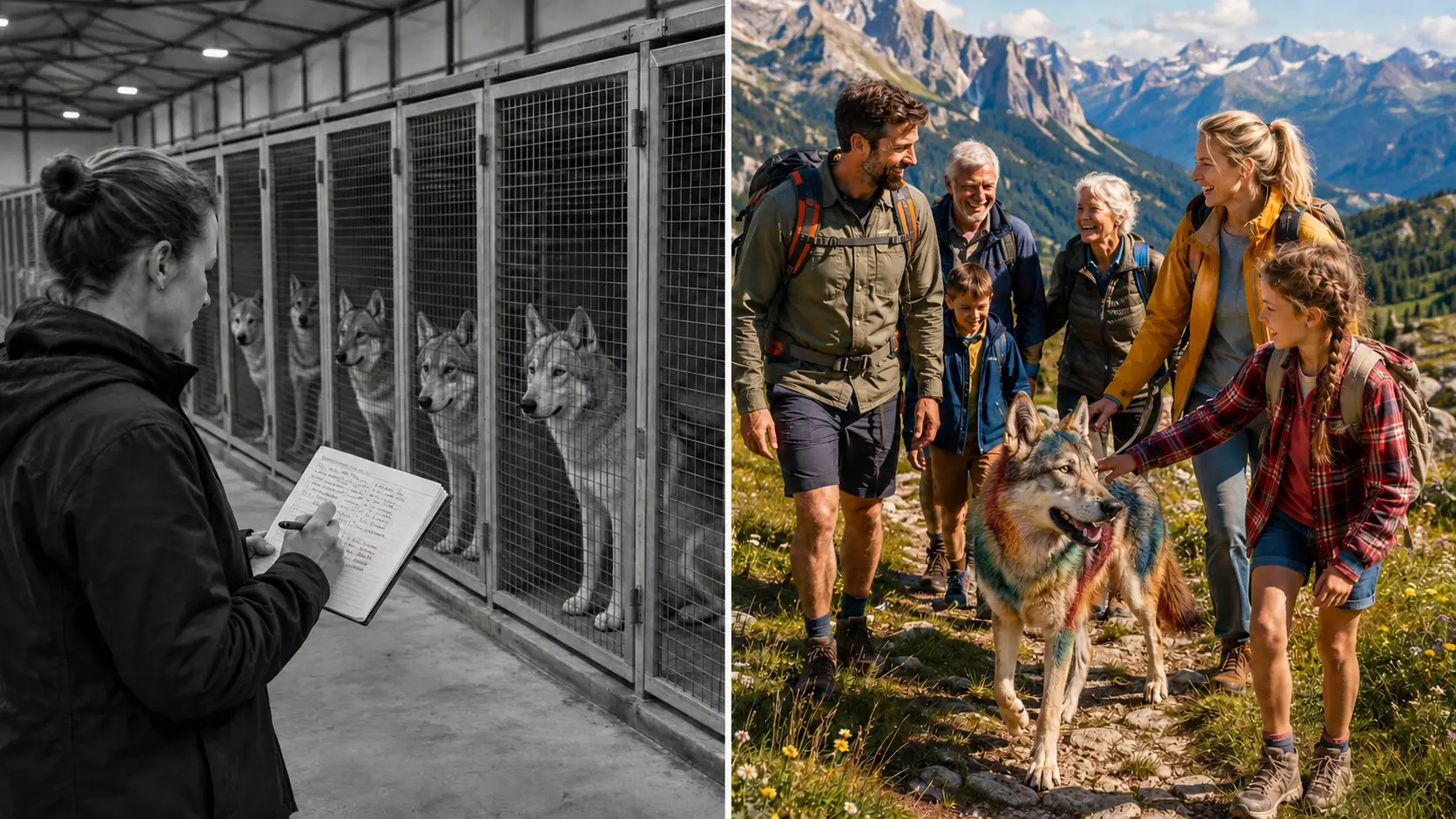
Kennels: large numbers of dogs, with data gathered outside their real-life context.
The family home, SaarGen’s choice: observing a dog in its real life, allowing its temperament to express itself fully.
02
An active, willing partnership
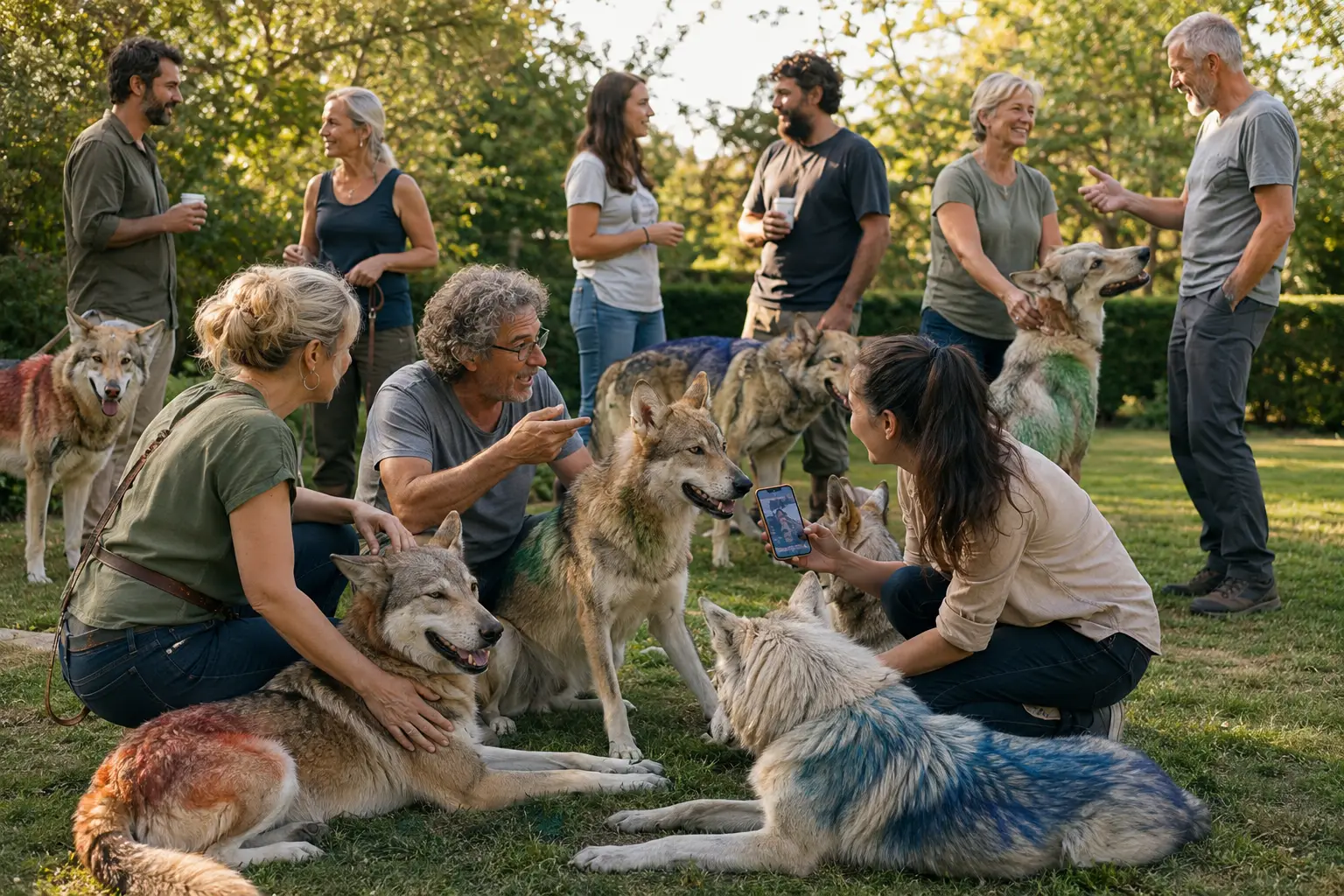
Adopting a SaarGen puppy calls for a particular commitment. The adopting family does more than give the puppy a home: it becomes a partner in the program.
This partnership begins with keeping in regular contact with SaarGen. Information shared over the months and years helps us better understand each dog’s development and refine breeding decisions for future generations.
Families do not need to become specialists in genetics or ethology. SaarGen supports adopters, explains each stage, and remains available throughout the dog’s life. However, genuine commitment is essential: following a SaarGen dog’s development is a shared responsibility.
The commitments
Families agree to:
Alongside giving their dog a good life.
Stay contactable and keep in touch with SaarGen.
Share important updates on their dog’s health and behavior.
Make time for the rare follow-up occasions — a meeting during the dog’s lifetime, a dog show.
Take part in the health examinations planned by the program.
Follow the program’s breeding rules.
No specialist knowledge is needed. SaarGen explains every stage and remains available.
03
Limited, carefully planned breeding
When the dogs are around one year old, SaarGen will review the information available for each litter. Based on this assessment, ideally, at least one male and one female per litter may be selected to contribute to the next generation of the program.
Each selected dog may then contribute to a single transition litter during its lifetime. SaarGen will plan and support this breeding in line with the overall genetic strategy.
This does not mean asking every adopter to become a breeder. Breeding is exceptional, limited, and serves a specific purpose: passing on genetic diversity under the best possible conditions while preserving the behavioral qualities and identity of the Saarlooswolfdog.
Breeding outside the program with traditional Saarlooswolfdogs is strictly prohibited. This rule is essential to avoid confusion and maintain the consistency of the program’s work.
Your dog’s journey
3m
1a
+
Born and raised at home
Puppies grow up in the breeder’s home, with appropriate human contact and varied experiences.
Joining a family
DNA testing and parentage verification are completed before departure, so families know the puppy’s recorded origins and role in the program.
Litter assessment
One male and one female per litter may be selected for the next generation.
Lifelong follow-up
Health, behavior, and conformation.
04
Health monitoring
for the long term
SaarGen puppies join their families at three months of age. DNA testing and parentage verification have already been completed by then, giving families precise information about the puppy’s genetic origins and the elements analyzed within the program.
However, our follow-up does not end when the puppy leaves. SaarGen covers the costs of subsequent examinations scheduled to monitor the dogs' health.
This support helps reduce the financial burden on families and ensures consistent monitoring across different dogs. It also helps build a useful database for future decisions.
Health should not be viewed as a mere administrative formality. It is one of the cornerstones of preserving the breed: the more complete the information is, the more thoughtful and responsible future pairings can be.
Funded by SaarGen
Documented DNA, parentage, hips, elbows and eyes — genetic and health monitoring.
DNA tests
Completed before departure, together with parentage verification.
Hips
Radiographs planned by SaarGen.
Elbows
Radiographs planned by SaarGen.
Eyes
Eye examinations planned by SaarGen.
Additional genetic tests
Tests required for the particular line.
Scientific monitoring
Examinations requested as part of the program.
05
Breeders retain their choices, with SaarGen’s support
Breeders participating in SaarGen retain freedom over their day-to-day breeding choices.
Breeder choices
What the breeder decides
• Their diet
• Their organization
• Their adoption requirements, with the help of SaarGen's visibility to facilitate connections
• Their pricing policy
• Their own socialization activities, within the limits of a minimal stimulation framework
Minimum requirements
Every puppy must:
• Be born and raised in the breeder’s home
• Have regular, appropriate interactions with people
• Be introduced gradually to varied, unfamiliar places to support adaptability
SaarGen provides guidance through remote discussions.
SaarGen supports these choices to ensure that they meet the puppies’ needs and the program’s goals. This support extends beyond canine genetics to ethology and socialization, providing a holistic approach to puppy development. SaarGen does not seek to impose a single breeding model, but to support breeders through a coherent and reassuring process.
Breeders are free to organize their own puppy socialization activities, provided they meet minimum stimulation and welfare requirements.
SaarGen provides the sales contract as a basic framework. Breeders may add their own requirements and specific clauses, provided these are compatible with the program’s objectives. The contract formalizes each party’s commitments, particularly regarding follow-up, health, and breeding.
Financial transparency
10 %
of the puppy's price is set aside for SaarGen.
This sum is exclusively intended for:
Fund screenings
Support breeders.
Support follow-up of the dogs.
Run the program.
Maintain its continuity.
06
Adopting a SaarGen Puppy: Which Litter for Which Family?
SaarGen lines, particularly F1 lines, can differ considerably from one another. Each litter may have distinct characteristics in terms of sensitivity, energy, reserve, sociability, and support needs.
SaarGen’s role is to guide each family toward the litter or line that best suits it and to connect adopters with breeders.
This personalized guidance protects both the puppy and the adopter. It increases the chances of building a relationship that suits both temperaments.
Each litter is described with its particular characteristics, and we will help each adopter find the litter that best matches their expectations.
What SaarGen will discuss with you
These topics help us understand your circumstances.
They are a basis for discussion, not a points system or a set of automatic entry conditions.
Your experience with wolfdogs, if any.
Your home environment and activity level.
Children or other animals in the household.
The time you have available.
The activities you hope to share with your dog.
Your ability to meet the program’s commitments.
Planning
Establishing partnerships, preparing breeders, defining protocols, and organizing follow-up.
First litters
Expected launch horizon.
No litter is scheduled before that date.
The newsletter will announce the first SaarGen litters.
07
Conclusion
Adopting a SaarGen puppy means welcoming a companion into your family while contributing to a long-term vision for the Saarlooswolfdog.
The program rests on a demanding balance: following enough dogs to obtain useful data without ever sacrificing their welfare; introducing genetic diversity without losing breed identity; and involving families without asking them to shoulder the project’s responsibility alone.
Every adopter therefore plays a concrete role in safeguarding the Saarlooswolfdog. Through availability, observation, commitment and respect for the agreed framework, each becomes an active contributor to the breed’s future.
08
Key facts
09