
Population management:
why a breed cannot be preserved one litter at a time
Managing a dog population becomes essential when a breed’s future can no longer be safeguarded by individual breeding decisions alone.
A good mating can produce a good litter, but that is not enough to maintain a viable, diverse population with enough options for selection.
The challenge is collective.
Discover how to keep breeding options open for the future.
Key points
A breed needs more than a series of well-chosen matings to thrive. It also needs a shared commitment to retaining enough genetic diversity, available breeding dogs and scope for selection in future generations.
Problems arise when individual decisions seem sensible, yet together they gradually narrow the population’s options. A few dogs may become too popular, certain bloodlines may dominate, effective population size may fall, and valuable lineages may disappear.
The answer is not to take decisions away from breeders, but to make the population’s condition visible through meaningful indicators: birth trends, active breeding dogs, the balance between males and females, effective population size, genetic contributions, mean kinship, the fixation index, population structure and more.
The aim of dog population management is straightforward: to help breeders make decisions with the whole breed in view. A breed’s future cannot be managed one litter at a time. It requires a coordinated approach.
01
Purebred dog breeding is still often managed one litter at a time
Most breeding decisions begin with a practical question: which male should be paired with which female? That is a natural starting point. Breeders work with their own dogs, circumstances and priorities for breed type, health, temperament and availability.
Decisions at this level remain essential. Population management cannot replace a breeder’s judgement of their own dogs. But it is not enough when a breed is small, closed to outside breeding, or already closely related.
A litter can make sense for an individual breeder while still contributing to an unfavorable trend across the breed.
Studies of purebred dog pedigrees (Calboli et al. 2008) show how population structure, closed studbooks and unequal genetic contributions can increase relatedness and reduce diversity over time (Leroy, 2011).
Thinking only about the litter answers an immediate question: what will this mating contribute to my breeding program? Population management asks a broader one: what will it contribute to the breed’s future?
02
Why sensible individual decisions can produce a poor outcome for the breed
An individual decision can be careful, well reasoned and consistent with a breeder’s aims. Yet when many breeders make similar choices without coordination, the combined outcome can be harmful.
This is a familiar problem in small populations. Each choice may look acceptable in isolation. Taken together, however, those choices can reduce the number of bloodlines that actually contribute, concentrate reproduction in a few males, accelerate genetic drift and lead to the loss of rare variants.
In a closed population, selection acts on the diversity that remains; it cannot bring back variants that have already been lost. This is a central concern in conservation genetics: sustaining a population means limiting the loss of variation and the increase in inbreeding over successive generations (Frankham, Ballou & Briscoe, 2010).
The danger can therefore be easy to miss. No individual decision needs to have been obviously wrong for the breed to lose options. The problem may be that no one has monitored their combined effects.
Population management makes those effects visible. It places individual breeding choices within a measurable picture of the breed’s direction.
03
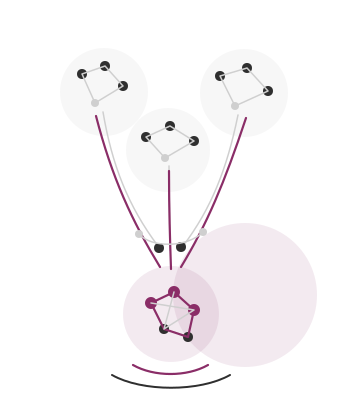
The best dog is not always the best choice for the population
Breeders naturally look for healthy, emotionally stable, functional dogs that show the desired breed type and meet the aims of their breeding program. Those qualities remain essential.
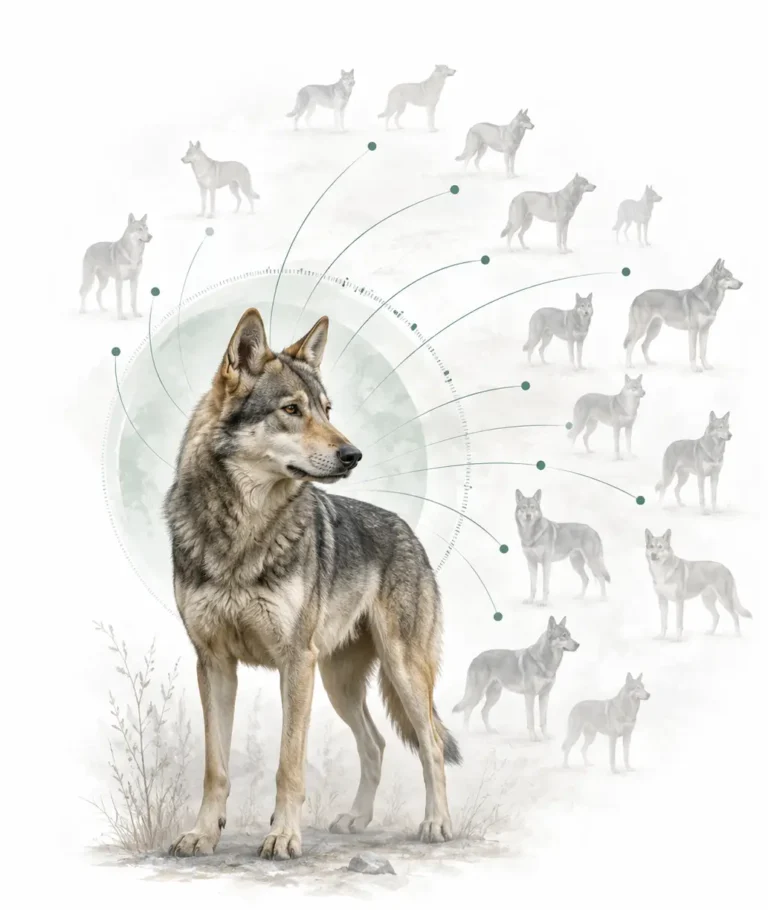
In a small population, however, the best individual dog is not always the best choice for the breed. An outstanding dog may belong to a bloodline that is already widespread. A less prominent dog may carry genetic variation that is rarer and more valuable to retain.
This is where a dog’s contribution to the population becomes crucial. Its value must be assessed both in terms of the litter it could produce and the variation it could add, preserve or further concentrate within the breed.
Mean kinship helps put this into perspective by measuring an individual’s relatedness to the reference population. Higher mean kinship suggests that its ancestry is already widely represented. Lower mean kinship can indicate a less common contribution worth preserving, provided the dog also meets the necessary standards for health, temperament and overall quality.
The familiar advice to “use the best dogs” therefore needs a more precise question: “among the suitable dogs, which will also help keep the population’s options open?”
04
Dog Population Management: What Should We Actually Monitor?
A breed cannot be managed through a single number. No inbreeding coefficient, DNA score or graph can describe the full condition of a population.
The question goes beyond “how inbred are these dogs?” We also need to ask: “does the population retain enough breeding dogs, diversity and options for future generations?”
Answering that requires several groups of indicators: reproductive demographics, effective population size, genetic contributions, relatedness, genomic diversity and population structure. Inbreeding coefficients and runs of homozygosity (ROH) add important detail, but they cannot replace monitoring of the breed as a whole.
Each measure tells us something different. The cards below show why they need to be considered together: some describe breeding activity, others track the population’s genetic direction, and others provide further detail from DNA.
05
Dog Population Management: From Breed Standard to Population Observatory
The breed standard remains a central reference. It defines the desired type and proportions, and sometimes expected abilities and behavioral traits. It helps make a breed recognizable.
But the breed standard does not measure genetic diversity. It does not tell us how many dogs actually contribute to reproduction, which bloodlines are disappearing, which sires are overused, or whether effective population size is being maintained. Population management can provide that information.
A modern breed club’s role should therefore extend beyond preserving the breed’s appearance. Especially in breeds with small populations, clubs should also collect, organize and publish the indicators that reveal how the population is changing.
Monitoring does not mean prescribing every mating. It means making trends visible: population numbers, births, active breeding dogs, the balance between males and females, inbreeding, diversity, underrepresented bloodlines, genetic contributions and developments across countries.
A breed club that does not provide these data leaves breeders without a clear view of the population Making the information accessible does not remove breeders’ responsibility. It helps them make better decisions.

06
Breeds cross borders, even when their management does not
Breed management is often organised nationally, through national clubs, rules, studbooks and breeding traditions. Genetics does not follow those administrative boundaries.
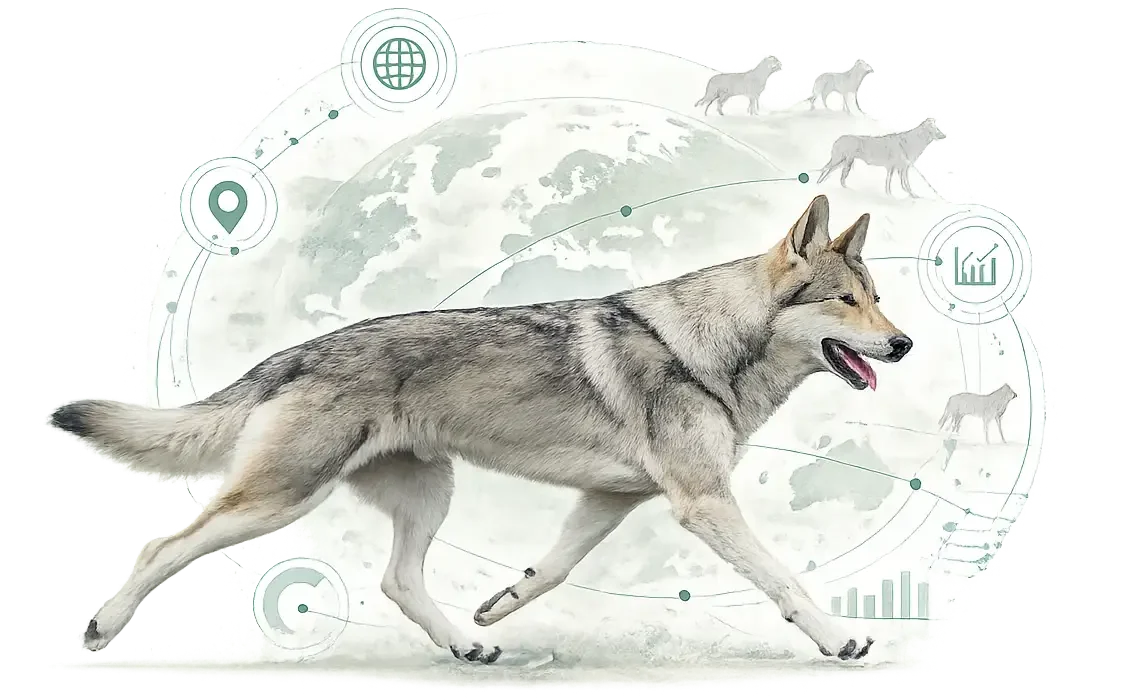
Dogs, imports, matings, bloodlines and descendants connect a breed across countries. A sire used in one country can influence several generations elsewhere. A bloodline overlooked locally may be important internationally.
Where it is justified, a breed cannot be assessed properly if every country looks only at its own dogs. Diversity may be overestimated when the same ancestry reappears under different kennel names, in different databases or through different breeding networks.
Sound population management distinguishes between national administration and an international genetic assessment. That distinction is especially important in breeds with small populations.
The relevant unit of analysis extends beyond a club, a kennel or a country. It is the breeding population connected through the actual exchange of genes.
07
Why a rigorous outcrossing program demands greater breeding responsibility
A rigorous outcrossing program is not a retreat from responsible breeding. When a population assessment shows that internal options are becoming inadequate, it is a more demanding form of population management .
The first step should always be to make better use of the diversity already available: limit overrepresentation, retain valuable bloodlines, broaden the pool of breeding dogs, monitor indicators and avoid repeatedly making the same choices. Outcrossing should not become an automatic response.
But when effective population size remains low, diversity is eroding, breeding options are narrowing and several indicators point in the same direction, refusing even to consider outside contributions can become a matter of ideology rather than strategy .
An outcrossing program does not succeed simply because a cross has taken place. The new variation must be retained, distributed, monitored and established in several viable breeding lines. Models of genetic rescue in dogs suggest that very limited outside contributions, or rapid backcrossing into the original population, can have only a limited effect (Windig & Doekes, 2018).
Where it is justified, outcrossing must therefore be planned as part of long-term population management, with a clear assessment, donor selection, monitoring across generations, measurable indicators and oversight.
08
Dog Population Management: What It Changes for Breeders
For breeders, population management means making better-informed decisions.
A dog is no longer chosen solely for its appearance, recent pedigree, health test results or availability. Its contribution to the wider population also matters. Is its bloodline rare or already common? Is its mean kinship high? Could its descendants further concentrate ancestry that is already overrepresented?
This means accepting that the best choice for a litter is not always the most convenient one. Sometimes, maintaining a healthy but little-used line may be more valuable than returning to one that already dominates the population.
Rarity alone, however, is no reason to breed from an unsuitable dog. Health, temperament and overall quality remain essential. A valuable, underrepresented genetic contribution becomes one consideration among those priorities.
In practice, breeders look beyond what a mating could produce in one litter. They also consider what it could preserve, pass on or prevent from becoming further concentrated across the breed.
09
What population management changes for breed clubs
For breed clubs, population management means extending their role beyond setting standards to coordinating the breed’s long-term direction. The breed standard remains necessary, but it is not sufficient.
A club should also be able to provide a clear set of monitoring data: trends in births and litter numbers, the numbers of males and females used for breeding, the distribution of genetic contributions, changes in effective population size, underrepresented or declining bloodlines, and inbreeding trends.
This work can develop gradually, without prescribing every mating. The first step is to make imbalances visible; the next is to help breeders understand the consequences of their choices.
Clubs can also encourage useful action: limiting overuse of individual dogs, recognising the value of healthy but underrepresented bloodlines, documenting descendants, using consistent calculation methods and publishing accessible summaries.
A breed club’s credibility rests on more than its defence of the standard. It also depends on its ability to demonstrate that the population remains viable and is being monitored and actively managed.
10
SaarGen: managing the population before, during and after outcrossing
SaarGen follows this approach: population management before, during and after outcrossing. A program does not begin with its first litter. It begins with the population assessment that establishes why outside contributions should be considered.
Before outcrossing, the population’s condition must be understood: available diversity, effective population size, active breeding dogs, mean kinship, ROH, underrepresented bloodlines, the limits of selection within the breed and the program’s priorities.
During outcrossing, donor dogs must be selected for what they can contribute genetically and in terms of health, temperament and function. A donor is more than an outside dog: it introduces variation that must be followed across several generations.
After outcrossing, retaining the new variation becomes even more important. This means establishing several breeding lines, avoiding rapid backcrossing into the original population, and monitoring health, temperament, fertility, breed type, genomic data and the genetic contributions of descendants.
SaarGen’s task will be to turn those new genetic contributions into useful options for the Saarlooswolfdog population. Calling a program scientific is not enough. Its credibility must come from measurable indicators, documented decisions and follow-up across generations.
11
Preserving a breed means safeguarding its future breeding options
Preserving a breed means more than producing good litters today. It means retaining enough options to keep breeding in the future, without narrowing the possibilities with every generation.
Breeders remain central to that work. Their judgement, standards and experience are irreplaceable. In a small population, those strengths need to be informed by an understanding of the breed as a whole.
Breed clubs also have a part to play. Their role must extend beyond standards, dog shows and administration. They need to help make the population visible, measurable and understood.
Population management therefore calls for a broader perspective:
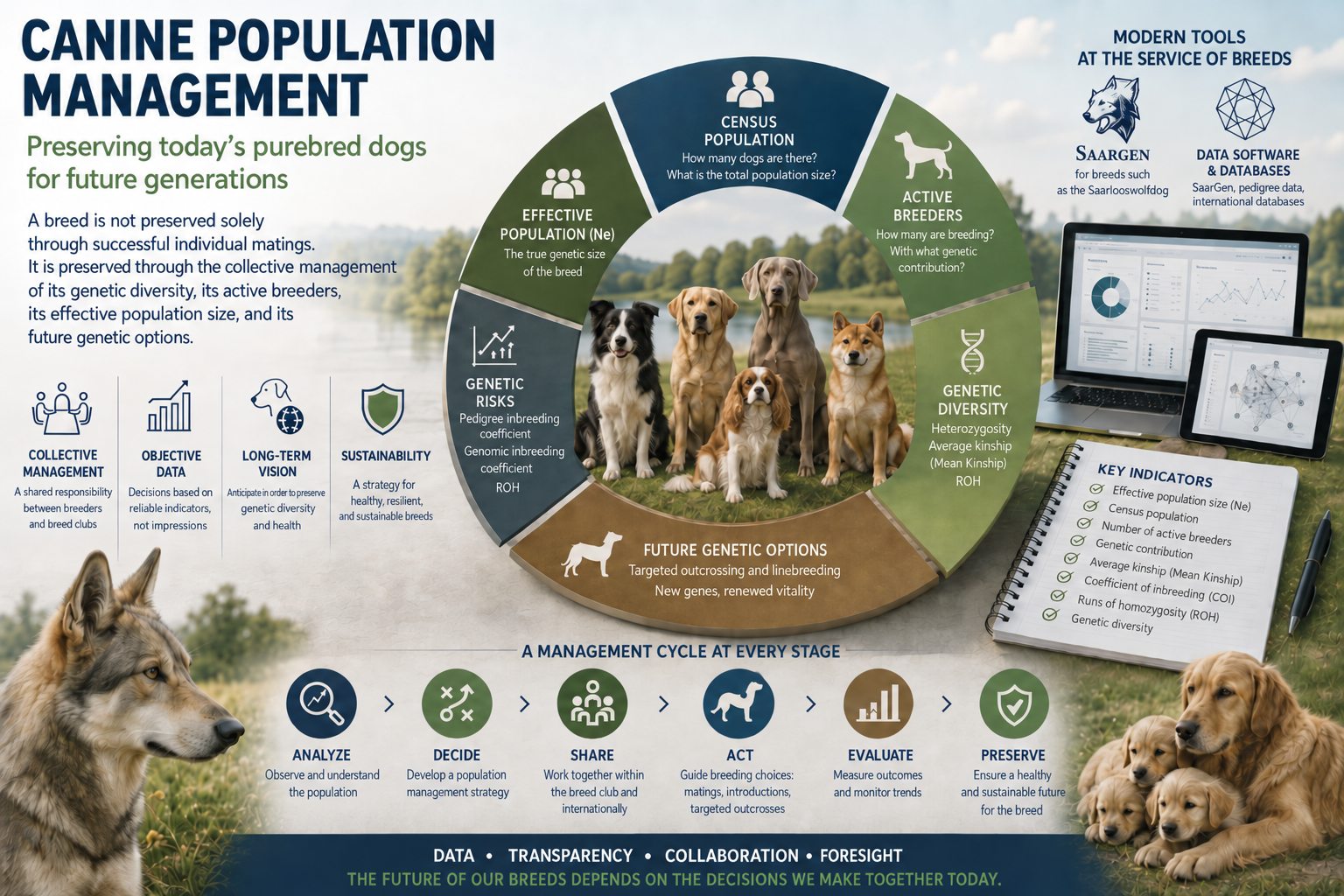
Before considering individual matings, we need to understand the breed as a whole: how many dogs there are, how many contribute to the next generation, which bloodlines persist, which disappear, and how to guide future choices.
Mini-glossary
FAQ - Frequently Asked Questions
What does Ne mean in a dod population?
Ne means effective population size. It is not the total number of dogs. It is a theoretical size describing how many breeding dogs actually contribute to the next generation and how balanced the sexes are. The lower Ne is, the faster genetic drift and the rise in inbreeding can be.
How does census population size differ from effective population size?
Census population size counts known or registered dogs. Effective population size, by contrast, focuses on the dogs that breed and therefore actually pass on their genes. A breed can have many registered dogs but a low effective population size if few males and females breed or if some contribute far more than others.
An analysis of 215 breeds recognised by the UK Kennel Club showed that effective population size is not the same as registration numbers, and that disproportionate use of certain sires is a major factor in increasing inbreeding and losing genetic diversityLewis, Abhayaratne & Blott, 2015).
I’ve heard of a Hardy–Weinberg ideal population. What is it?
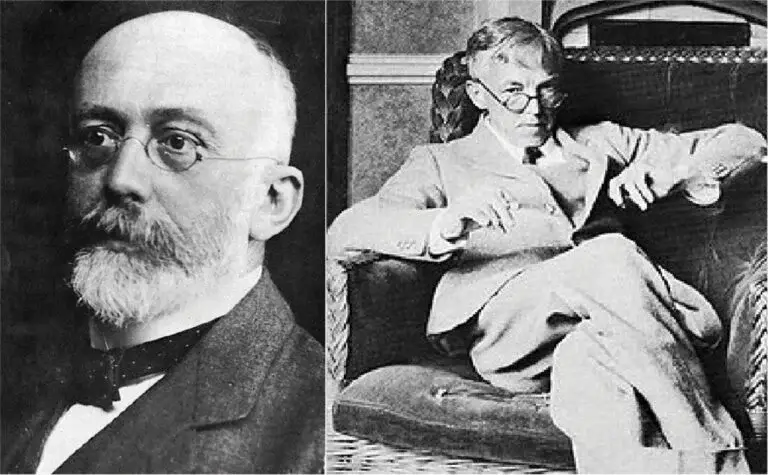
Hardy–Weinberg is a reference model describing a theoretically ideal population.
An ideal population would meet all of the following criteria:
1. Equal numbers of breeding males and females. all have the ability to procreate.
2. Variation in reproductive success determined only by random sampling.
3. Random mating, without selection.
4. A constant number of breeding individuals across generations, with no migration or mutation.
In an ideal population meeting these criteria, population size equals breeding population size. In reality, purebred dog populations do not meet the criteria of an ideal population: the sexes are not necessarily balanced, and breeding is controlled rather than random, for example. In these populations, the number of breeding dogs is lower than the total number of dogs produced.
If real populations are rarely ideal, why is effective population size worth knowing?
The genetics of ideal populations is predictable, unlike that of real populations. Because purebred dog populations are not ideal, their effective population size must be determined to make reliable genetic predictions.
Why does a smaller effective population size (Ne) lead to stronger genetic drift?
This video explains the relationship between genetic drift and effective population size.
Why does the balance between breeding males and females affect effective population size (Ne)?
A breed with 1,000 active breeding dogs might seem well placed. But if those dogs include 900 males and only 100 females, the total alone is misleading. An imbalance between the sexes reduces effective population size under the simple model. A standard approximation is Ne = 4 × (Nm × Nf) / (Nm + Nf), where Nm and Nf are the numbers of breeding males and females. With 900 males and 100 females, this gives an estimated Ne of 360. Effective population size depends on the balance of contributions as well as the number of dogs.
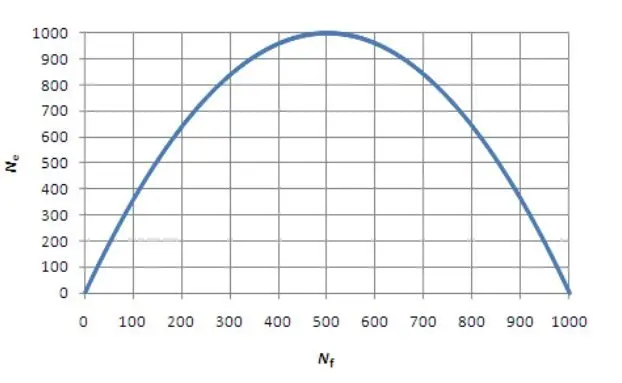
The blue curve shows how an unequal sex ratio affects effective population size in this model.
Horizontal axis: Nf (breeding females)
Vertical axis: Ne (effective population)
Example 1: a breeding population of 1,000 dogs with 500 females and 500 males gives Ne = 1000
Example 2: a breeding population of 1,000 dogs with 200 females and 800 males gives Ne = 640.
Does a high effective population size (Ne) prove that a breed is well managed?
No. Ne is useful, but it cannot establish that on its own. It needs to be considered alongside genetic diversity, ROH, mean kinship (Mk), the contributions of different bloodlines, health, temperament and the distribution of breeding activity. No single measure can tell the whole story.
Does a breed club need to dictate matings to improve effective population size?
No. It can start by publishing indicators, highlighting imbalances, helping limit overuse of particular dogs, and encouraging the retention of healthy, underrepresented bloodlines. Population monitoring supports an advisory role.
Is using a dog from further away enough to benefit the population?
No. Geographical distance is not a measure of genetic distance. A mating with a dog from another country benefits the population only if the dog makes a sufficiently distinct contribution, its ancestry is not already overrepresented, and its descendants continue to contribute through breeding over time.
Can a breed be preserved simply by maintaining several kennel lines?
Only if those lines are genuinely distinct and their contributions remain balanced. Lines with different names can share the same dominant ancestors. Conservation therefore needs to be assessed through genetic contributions, mean kinship and overall population structure, rather than kennel names or recent pedigrees alone.
How can PCA help with breed management?
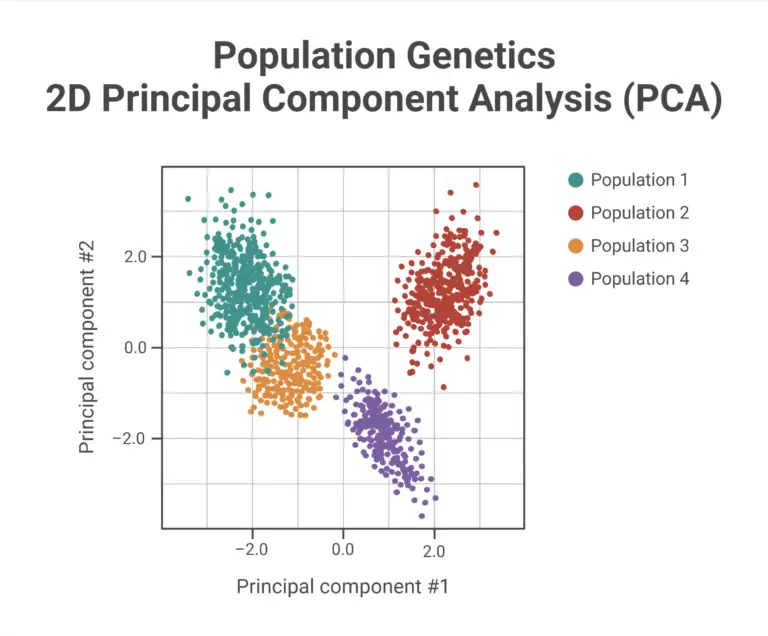
Principal component analysis allows us to visualise a population’s genetic structure. It can show whether groups are genetically close, separate or isolated. It does not tell us which dogs are “better”, but helps explain how the population is structured.
In the example below, population 1 (green) is genetically closer to population 3 (orange) than to populations 2 (red) and 4 (purple). Depending on the context, which we do not know here, we might interpret population 2 (red) as having genetically drifted away from the other three.
Scientific references
The sources below informed this article.
Links to the relevant publications are included in the text.
1. Bannasch, D., Famula, T., Donner, J., Anderson, H., Honkanen, L., Batcher, K., Safra, N., Thomasy, S., & Rebhun, R. (2021). The effect of inbreeding, body size and morphology on health in dog breeds. Canine Medicine and Genetics, 8(1), 12. DOI : 10.1186/s40575-021-00111-4.
2. Calboli, F. C. F., Sampson, J., Fretwell, N., & Balding, D. J. (2008). Population structure and inbreeding from pedigree analysis of purebred dogs. Genetics, 179(1), 593-601. DOI : 10.1534/genetics.107.084954
3. Falconer, D. S., & Mackay, T. F. C. (1996). Introduction to Quantitative Genetics. Longman.
4. Frankham, R., Ballou, J. D., & Briscoe, D. A. (2010). Introduction to Conservation Genetics. Cambridge University Press.
5. Hardy, G. H. (1908). Mendelian proportions in a mixed population. Science, 28(706), 49-50.
6. Kardos, M., Luikart, G., & Allendorf, F. W. (2015). Measuring individual inbreeding in the age of genomics: marker-based measures are better than pedigrees. Heredity, 115(1), 63-72. DOI : 10.1038/hdy.2015.17.
7. Leroy, G. (2011). Genetic diversity, inbreeding and breeding practices in dogs: results from pedigree analyses. The Veterinary Journal, 189(2), 177-182. DOI : 10.1016/j.tvjl.2011.06.016.
8. Meuwissen, T. H. E., & Luo, Z. (1992). Computing inbreeding coefficients in large populations. Genetics Selection Evolution, 24, 305-313. DOI : 10.1186/1297-9686-24-4-305.
9. Meyermans, R., Gorssen, W., Buys, N., et al. (2020). How to study runs of homozygosity using PLINK? A guide for analyzing medium density SNP data in livestock and pet species. BMC Genomics, 21, 94. DOI : 10.1186/s12864-020-6463-x.
10. Weinberg, W. (1908). On the demonstration of heredity in man. Jahreshefte des Vereins für vaterländische Naturkunde in Württemberg, 64, 368-382.
11. Windig, J. J., & Doekes, H. P. (2018). Limits to genetic rescue by outcross in pedigree dogs. Journal of Animal Breeding and Genetics, 135(3), 238–248. DOI: 10.1111/jbg.12330.
12. Lewis, T. W., Abhayaratne, B. M., & Blott, S. C. (2015). Trends in genetic diversity for all Kennel Club registered pedigree dog breeds. Canine Genetics and Epidemiology, 2, 13. DOI: 10.1186/s40575-015-0027-4.