The SaarGen approach
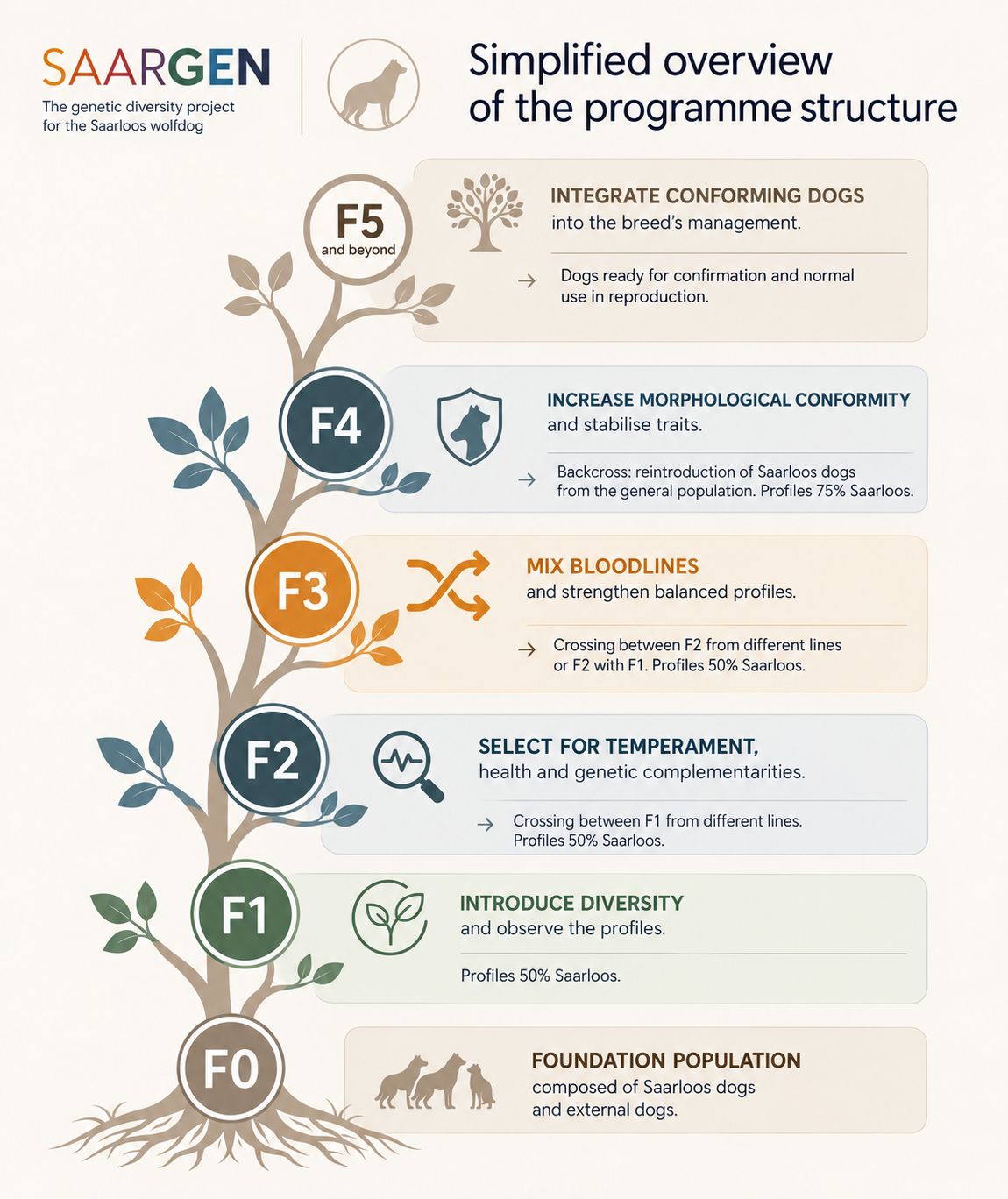
SaarGen follows a gradual approach: establishing several founder lines, selecting for temperament and health, monitoring genomic indicators, and refining conformation over successive generations.
The program starts from a simple premise: preserving a breed means more than maintaining its appearance.
For the Saarlooswolfdog, this is particularly important. The breed has a distinctive identity, but that identity can endure only if the population remains genetically viable.
SaarGen brings these priorities together in a program that introduces several founder lines, selects for health and temperament, monitors genomic change, works towards the desired conformation over time, and builds cooperation between breeders and owners.
The aim is to preserve the Saarlooswolfdog’s identity while giving the breed more options for a lasting future.
Building a future for the Saarlooswolfdog takes time, a clear method and shared responsibility.
Step 1
Founding Lines in the SaarGen Methodology
The first step is to introduce several outside founder lines that are sufficiently genetically distinct from the target population.
F1 refers to the first cross between a Saarlooswolfdog and an outside founder. At this stage, offspring may vary considerably, both between litters and within the same litter. Some Saarlooswolfdog characteristics may be less apparent, while other traits may emerge unexpectedly.
This variation is not a failure. It is expected. It provides the raw material for selection.
Each line needs to be documented, monitored and assessed over time.
The aim extends beyond producing a first generation: it is to establish breeding lines capable of making a lasting contribution to the Saarlooswolfdog population.
Step 2
Selecting for temperament, health and conformation
Temperament is a priority too
For SaarGen, temperament is as important as health. The Saarlooswolfdog is sensitive and often reserved. These qualities should be retained in a balanced form.
Health
Genetic diversity does not replace selection for health. Breeding dogs need to be assessed using known health risks, family history and DNA test results. Genetic tests can identify particular variants associated with inherited disease, but their results must be considered in context. A single test cannot describe the overall health of a dog or its population.
Working towards breed type over time
Conformation remains essential to preserving the Saarlooswolfdog’s identity, but it should not be the first selection filter in the early generations: unlike genetic diversity and temperament, it is the easiest aspect to change. An F1 dog may be genetically valuable without immediately showing the expected appearance. Applying strict conformation criteria too early would exclude dogs carrying a valuable genetic contribution.
The following behaviours, however, should not be treated as normal expressions of breed sensitivity:
The aim is to encourage a Saarlooswolfdog that remains true to itself while becoming more stable, more considered in its responses and more adaptable. socialization also plays an important role: a balanced dog need not seek contact with everyone, but must be able to navigate a consistent everyday environment with ordinary, progressive socialization.
Step 3
From F1 to F5: The Saarlooswolfdog Outcross Method
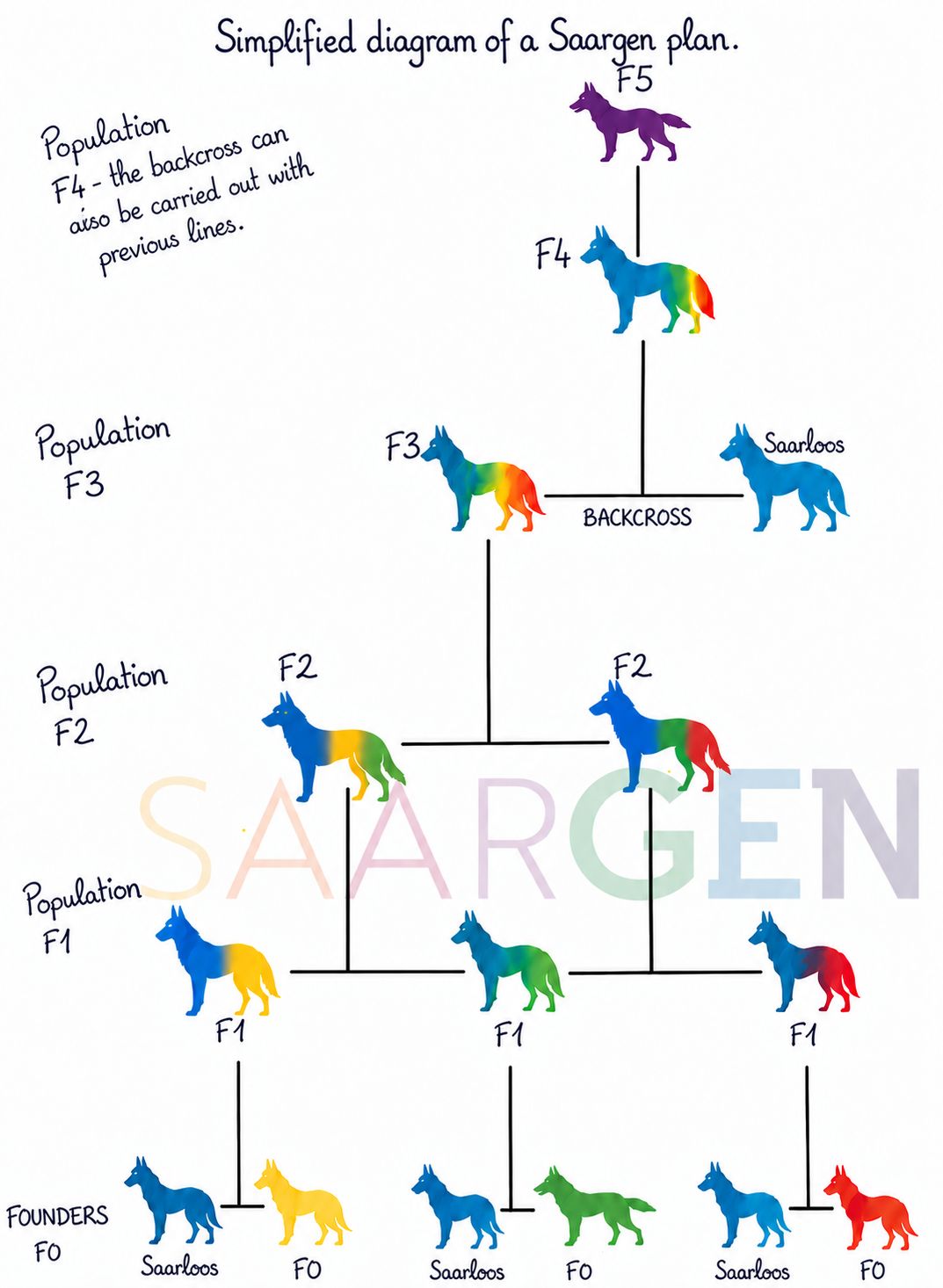
The diagram below illustrates the basic structure of the program. It is intentionally simplified: each dog shown represents a population, not a single individual. In practice, the program calls for at least two litters per line, with one male and one female retained from each litter to continue breeding within the program.
Every birth provides an opportunity to reassess the strategy. Backcrossing may involve either a Saarlooswolfdog from the general population or other suitable outcross descendants to stabilize desirable traits. A new external founder may be introduced at any time. In the SaarGen methodology, this diagram serves as a compass, not a fixed plan.
Early stages
F1 to F3
The early generations establish the foundations:
- Identify the most suitable temperaments.
- Assess health and genetic contributions.
- Avoid concentrating descendants in a single family.
- Monitor changes in COI, AVK and ROH.
- Keep several options open for later generations.
Patience is essential during this period.
A generation should be assessed for its potential contribution to the population, not solely for its immediate appearance.
Later stages
F4, F5 and beyond
In later generations, selection can aim for closer conformity to Saarlooswolfdog breed type while retaining the genetic gains achieved.
The goals include dogs recognizable as Saarlooswolfdogs, more stable and balanced temperaments, greater genetic diversity and gradual integration into the wider population.
F5 is not an absolute endpoint. It is a stage at which some dogs may conform closely enough to contribute to a new approach to genetic maintenance.
A population of at least 30 dogs should be available for breeding with the wider population. Even beyond F5, sound management requires a fresh outcross contribution roughly every ten years (and this applies to all dog breeds).
Step 4
Every puppy matters
Within the SaarGen methodology, each litter is a resource for future generations. In theory, SaarGen aims to retain at least one male and one female from each litter as potential breeding candidates for the program. This decision is not made at birth; it is made after the dog is at least one year old, once its temperament, health, and development can be assessed with sufficient perspective.
For optimal selection, each individual would ideally be observed through maturity. This is obviously impossible at the scale of a program producing many puppies. Collaboration with adopters is therefore essential: they give each puppy a fulfilling family life while keeping the dog connected to the program, monitored, documented, and potentially available for breeding if its profile proves valuable for the future.
The Team