
Outcrossing in dogs:
why it fails without a population strategy
An outcross can change a pedigree without changing a breed’s future.
If the external input is poorly stored, poorly distributed, or absorbed too quickly, it becomes a genetic parenthesis.
Everything is at stake in the following generations.
Key points
The real debate is not “for or against outcrossing”. That question creates the illusion of a simple choice while avoiding the essential assessment: does the population still have enough diversity to allow selection without further depletion?
As diversity declines, a breed can retain its appearance while losing some of its ability to endure. The same ancestors recur, the same genomic segments become concentrated again, and breeding options diminish. The standard may still be met while biological options disappear.
Outcrossing is not a magical escape route. It can bring diversity, heterosis and new scope for selection. But these benefits survive only if the program retains the introduced contribution instead of diluting it too quickly.
A serious conservation plan expands options, establishes several usable branches, measures effects and then manages the population with greater responsibility than before the program.
Why Outcrossing in Dogs Provokes So Much Debate
Improvement crosses in purebred dogs provoke strong reactions because they touch three sensitive areas: breed identity, breeders’ legitimacy and the fear of losing what has been built. The debate quickly becomes a moral confrontation between defenders of purity and supporters of crossing.
This opposition obscures the real issue.
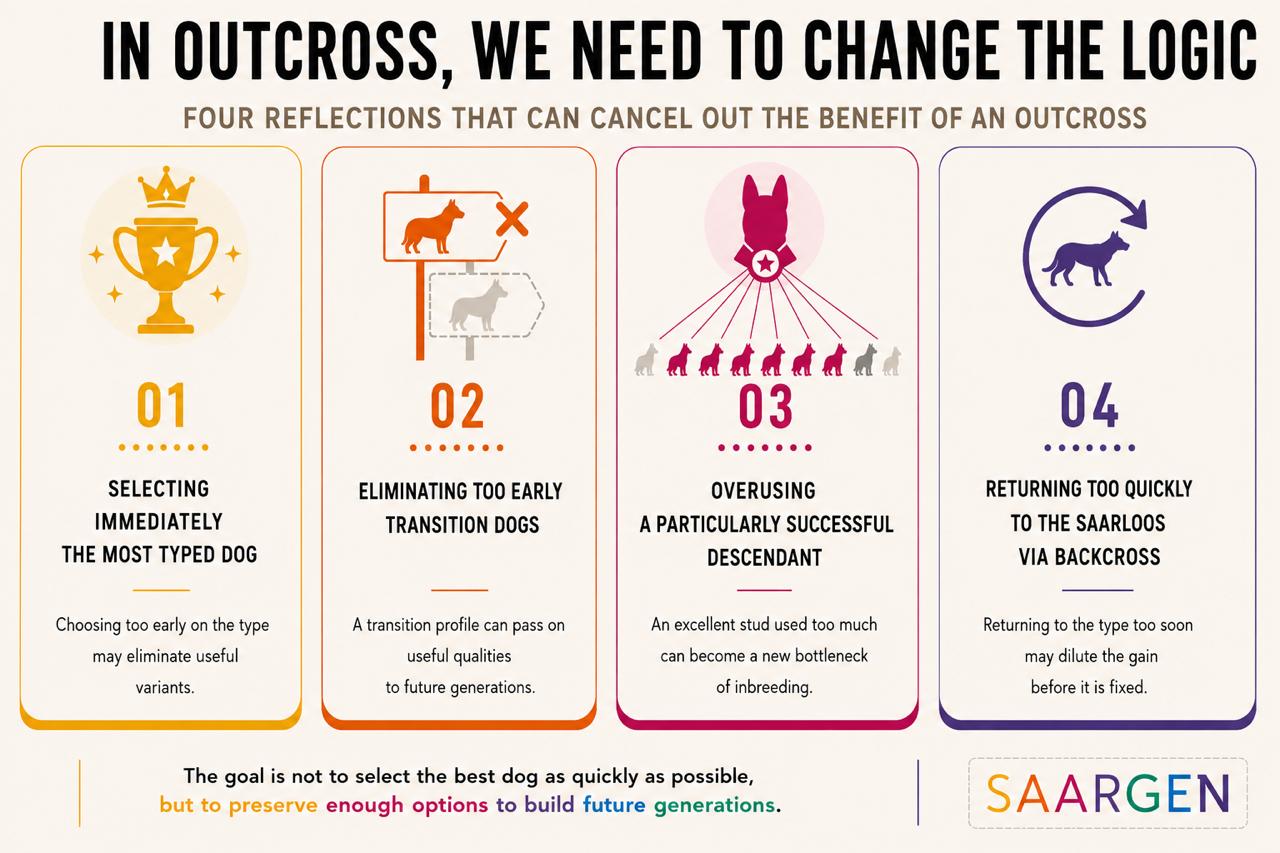
The question is not whether outcrossing is “good” or “bad”, but whether a closed population still retains enough genetic diversity for breeders to continue selecting without further depletion. The reverse is also true: a poorly planned outcross can introduce risks, disrupt breed type and create the illusion of a solution. Outcrossing fails when approached with the same reflexes as purebred breeding: seeking too quickly the dog that resembles the final ideal, excluding atypical descendants too early, returning abruptly to the same bloodlines and confusing a successful litter with a population strategy.
This article therefore does not defend crossing on principle. It argues for a more demanding idea: outcrossing makes sense only as a genetic management tool, directed over several generations with data, criteria and clear governance.
Outcrossing in Dogs: A Population Strategy
Reducing outcrossing to a single mating is the first mistake. A mating produces a litter, whereas a population strategy aims to change a group’s genetic trajectory over the long term.
In a serious breeding program, the first cross isn’t the ultimate goal. It’s the starting point. The most important decisions come next: which offspring to track, which to breed, which lines to preserve, which backcrosses to the original breed to accept, and at what rate.
The outcross program introduces an individual from outside the target population to provide diversity that is absent, rare, or has become insufficient. This individual is not merely a breeding animal. It becomes a founder, a genetic resource. It must therefore be evaluated as such: health, temperament, conformation, functional compatibility, available data, known risks, family stability, and population-wide benefits.
A traditional breeding approach, by contrast, often seeks the best individual for a better litter. An outcross approach focuses primarily on creating options for future generations. The difference is significant.
A visible, spectacular, or highly publicized litter F1 proves almost nothing. What matters is the ability to transform that initial contribution into truly usable diversity without losing sight of the breed goal.
The standard protects what is visible, not all diversity
The breed standard is necessary. It describes breed type, silhouette, certain proportions, and sometimes expected abilities or behavioral traits. It makes a breed recognizable.
But the standard primarily protects phenotype—the visible traits. It does not automatically protect genetic diversity, which cannot be seen.
A population can continue to meet the standard while becoming increasingly homogeneous. It can produce typical, recognizable, prize-winning dogs while losing variants useful for fertility, immunity, robustness, or future selection. It can also accumulate recessive alleles waiting to be expressed through homozygosity.
This is the blind spot in thinking exclusively in terms of pure breeding: assuming that preserving appearance is enough to preserve the breed.
Preserving a breed therefore involves more than preserving its image. We must also preserve what allows it to continue producing viable, selectable, coherent dogs in the future. The standard provides direction. It does not measure mean kinship, ROH, founder loss, or the diversity that is actually available.
When selection within the breed is no longer enough
Selection within the breed is always the first option. Before opening a population, we must make proper use of what exists: diversify breeding dogs, limit popular sires, preserve underrepresented bloodlines, compare kinship, monitor inbreeding and avoid unnecessary concentration.
But this strategy has a simple biological limit: in a closed population, selection sorts what already exists. It cannot recreate lost variants.
When the genetic base is too narrow, options diminish. Breeders can still choose, but among dogs already closely related. Recent pedigrees may suggest distance while the population shares extensive background relatedness.
Several warning signs then matter: low effective population size, few founders, rising inbreeding, high mean kinship, long ROH, falling births, fragile fertility, recurring diseases or a practical inability to find genuinely complementary combinations.
No indicator is sufficient alone. But when several signals converge, refusing even to examine outcrossing becomes an ideological stance. And ideology is not a conservation method.
What Outcrossing Can Bring to Dogs: Diversity, Heterosis, and New Scope for Selection
The first expected contribution is genetic diversity. An outside donor can introduce alleles or combinations that have become rare or absent in the target population. However, this gain has value only if retained over time.
A second possible benefit is heterosis, or hybrid vigour. Some crossbred descendants may show better vitality, fertility or robustness, particularly because the expression of harmful recessive variants identical by descent has been reduced.
But heterosis is not guaranteed. It does not affect every trait, remove the donor’s risks or replace selection. The slogan “crossing improves health” is inadequate. It can become as dangerous as the opposite claim that any cross destroys a breed.
The most strategic benefit lies elsewhere: outcrossing can restore room to manoeuvre. More diversity means more choice, and therefore greater scope to select without becoming trapped among the same ancestors. In a breed with a small population, this scope can be even more valuable.
The goal is therefore not simply to produce a few less-inbred dogs, but to establish usable branches, preserve their complementarity and maintain enough options for subsequent generations.
Successful Outcrossing Requires a Different Way of Thinking
This is where many programs fail. They change tools, but keep the same mental software.
The outcross fails when approached with the mindset of raising it as a pure breed.
First reflex: immediately look for the descendant that most closely resembles the original breed. This is understandable, but dangerous. At first, the descendant that most closely resembles the original isn't necessarily the most genetically useful.
Second reflex: eliminating transition dogs too early. Some will not be breeding stock, obviously. But others may carry a significant portion of the desired contribution, even if they do not yet match the final aesthetic standard.
Third reflex: massively reusing a single descendant deemed successful. We then recreate a bottleneck within the bottleneck.
Fourth reflex: returning too quickly to the dominant lines of the original breed through backcrossing. The pedigree then gives the impression of a controlled return, but the genetic trajectory actually returns to the starting point.
An outcross therefore requires accepting an initially less comfortable phase: more variation, more trade-offs, more monitoring, and fewer immediate visual certainties. This is not a weakness. It is the price of a serious reconstruction.
Introducing diversity is only the beginning
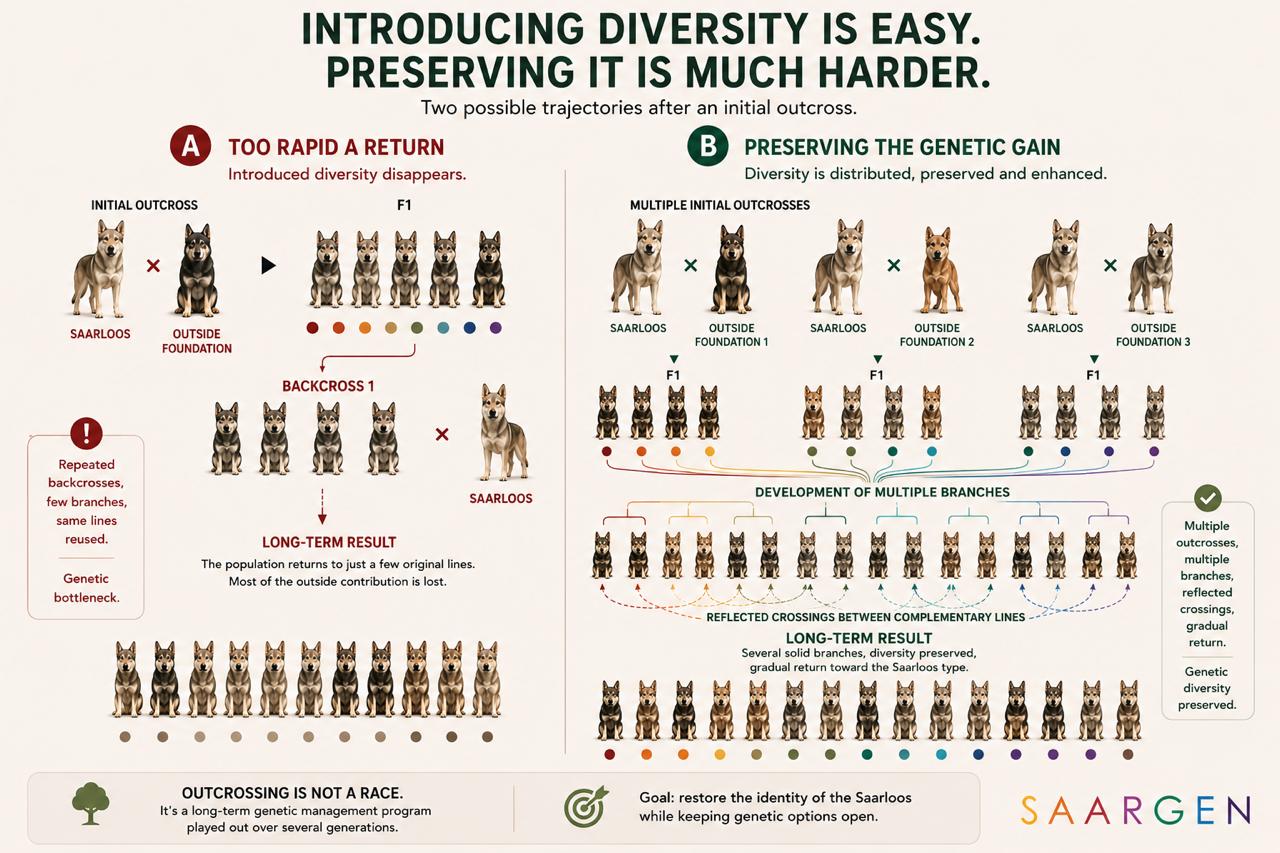
Introducing diversity is relatively easy. Maintaining it is much more difficult.
A breeding program can succeed in its first cross and fail thereafter. If the offspring are too quickly bred back to the same dominant lines, if only a single branch of the conservation program is used, or if selection brutally eliminates the individuals carrying the most outside genetic input, the initial benefit quickly melts away.
That is the trap of intensive backcrossing. Returning to the type is necessary, but returning too fast can cancel out some of the gain. You then end up with a pedigree that seems to tell of a new beginning, while the genetic structure returns to the old direction.
Preserving genetic gain requires adherence to several rules: creating multiple lines, avoiding overuse of a single descendant, tracking kinship, comparing ROH values, monitoring genomic diversity, and accepting that some functional dogs may not yet be the most visually appealing.
The real test of a dog outcross program is therefore not the first generation (F1). It lies in the ability to pass a useful share of the new contribution to later generations without losing the breed objective or closing the system again too quickly.
What Models and Real-World Dog Outcross Programs Show
Models and real examples confirm this difficulty. They show that outcrossing can be useful but fails when it remains isolated, narrow or followed by too rapid a return to the original population.
Windig and Doekes simulated several scenarios in dog breeds. Their conclusion is clear: in a highly inbred breed, a small number of outcross litters followed by rapid backcrossing does little to reduce the rate of increase in inbreeding. The effect becomes more valuable when the contribution is broad enough, repeated and integrated into a genuine population strategy.
The Norwegian Lundehund is also instructive. This genetically depleted breed underwent a managed crossing program involving several northern breeds. The aim was not to create a different breed, but to restore diversity while retaining distinctive traits.
Published analyses show the value of an outside contribution, but also how fragile the genetic gain becomes if later generations are managed too narrowly. The Lundehund therefore offers a useful lesson for the Saarlooswolfdog: the cross is not the program. The program truly begins when decisions must be made about retaining, distributing and using what has been introduced.
When Outcrossing Changes the Pedigree but Not the Genetic Trajectory
A program can show an opened pedigree through the introduction of several founders without profoundly changing its genetic trajectory. This is a major risk.
On paper, an outside donor seems to create a break with the past. But if descendants are rapidly absorbed into the usual bloodlines, the contribution becomes decorative. It changes the pedigree’s story, not necessarily the population’s structure.
Superficial indicators must therefore be treated cautiously. An outcross ancestor in a pedigree does not mean its genetic contribution remains usefully present. Across generations, that contribution can shrink, fragment and then disappear almost entirely, depending on breeding choices.
The danger is to promote “new blood” while the population continues to function as before: the same selection logic, the same overused bloodlines, the same low effective population size. The label changes, but the dynamics do not.
Avoiding this requires measuring the actual contribution, not simply recounting its origins: tracking genomic diversity, ROH, mean kinship, branches established and the distribution of descendants in breeding.
Without this discipline, outcrossing can become an illusion of reform.
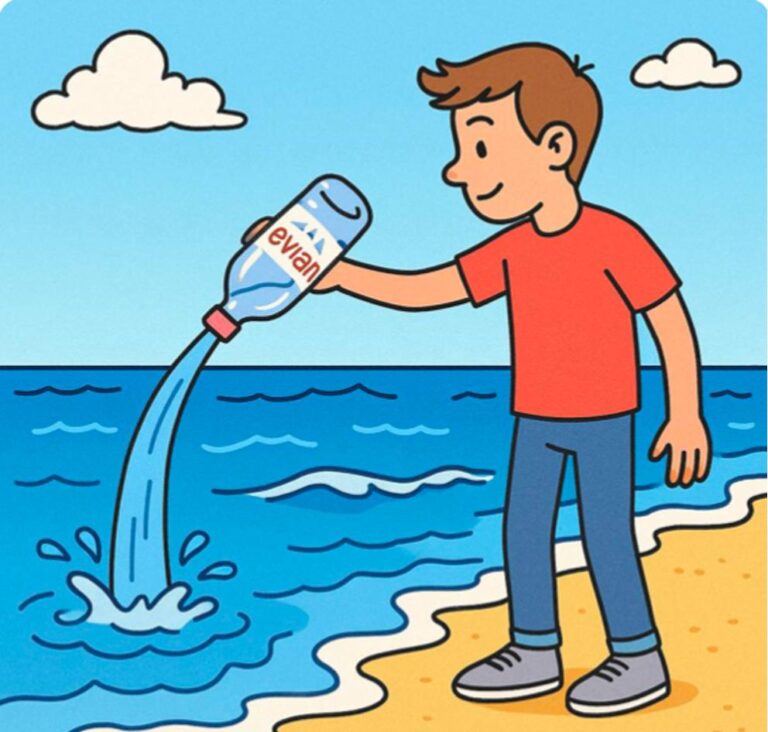
One bottle of fresh water makes little difference to a sea of salt water.
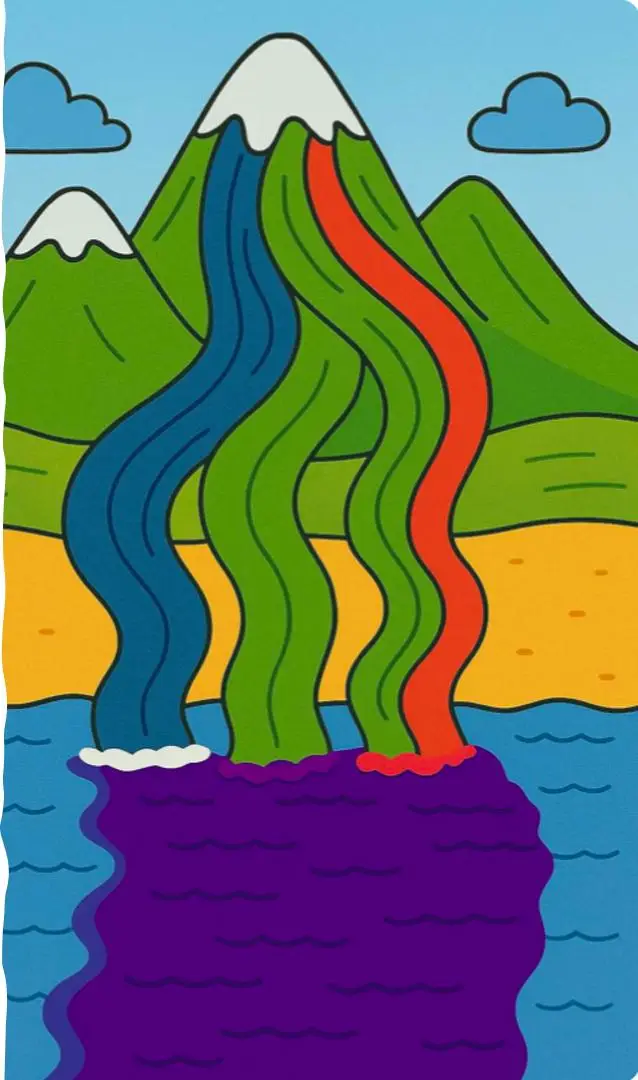
Several rivers supply a much greater, continuing flow of fresh water.
What Does a Rigorous Dog Outcross Program Look Like?
A rigorous dog outcross program begins with a clear assessment.
What weakness is the program trying to address: low diversity, excessive inbreeding, small effective population size, fertility, health, temperament, or conformation details? Without a clear assessment, the program has no direction.
The next step is to define the donor criteria.
A donor should not be chosen merely because it vaguely resembles the target breed or appears healthy. It must be assessed as a source of genetic, health, behavioral, and functional traits.
The program must also define which temporary deviations are acceptable.
A transitional descendant may differ from the final breed type without being useless. Conversely, certain shortcomings in health, behavior, or stability must remain non-negotiable. Follow-up must include both breeding dogs and dogs placed with families. Health, fertility, behavior, longevity, genomic data, breed type, and any difficulties encountered all matter. Failures must remain part of the analysis, not be hidden.
Finally, the program needs governance.
Who approves donors, maintains the data, decides whether a descendant may breed, and sets the warning thresholds?
A serious program must be able to outlast the people who launched it.
The central criterion is simple: data must circulate better than opinions.
Why this matters for the Saarlooswolfdog
The Saarlooswolfdog is directly affected because it combines several constraints typical of breeds with small populations: a narrow historical base, limited numbers, substantial background relatedness and restricted scope for selection.
This is not a claim that all dogs are ill or every line is unusable; that would be false and counterproductive. The problem is structural: in a limited, closed population, even good dogs can contribute to a dead end if options diminish with every generation.
Recent pedigrees covering three, four or five generations, depending on the country, can suggest distance. But that distance is insufficient if the population already shares extensive older ancestry. Genomic tools, particularly ROH and diversity measures, make this reality clearer.
The Saarlooswolfdog must be seen not only as a breed type to preserve, but as a population to maintain. This distinction is decisive.
Preserving it means preserving its appearance, movement and image as well as possible, but also its ability to produce viable, stable dogs that offer scope for selection and retain enough genetic diversity to avoid reliance on an ever-narrower circle of breeding animals.
SaarGen: creating options and managing them over time
SaarGen should be understood in these terms: reopening options, then managing them methodically. The aim is not to replace the Saarlooswolfdog with another dog, but to restore genetic scope compatible with the breed’s future.
This requires a clear direction.
SaarGen does not consider outcrossing a completed solution. One litter is not proof of success. One generation is not reconstruction. Success will depend on donor quality, follow-up of descendants, breeding choices and the ability to retain useful diversity.
SaarGen must also avoid returning too quickly to the desired appearance. Returning to the Saarlooswolfdog’s overall identity is essential, but must not come at the cost of immediately losing the introduced genetic contribution.
The program will therefore combine several levels of decision-making: pedigree, genomic inbreeding coefficient, ROH, mean kinship, health, temperament, breed type, fertility, bloodline contributions and the complementarity of future matings.
SaarGen’s credibility will not come from the word “science”, but from decisions that are traceable, open to revision and understandable to the public. Transparency will not be an extra communication feature. It will be a requirement for taking the program seriously.
Conclusion
The real choice is not purity or crossing. That opposition is too simplistic for a vulnerable population.
The real choice is between preserving an image while ignoring genetic erosion and managing a population clear-sightedly, even when that means changing tools.
Outcrossing is neither a betrayal nor a magic solution. It is a demanding tool, justified only when the assessment requires it. It succeeds only if management of subsequent generations is more rigorous than the management that led to the problem.
Outcrossing fails when approached with the reflexes of purebred breeding.
For the Saarlooswolfdog, the issue is not choosing between identity and diversity. It is understanding that identity cannot survive in the long term if the population carrying it loses its ability to endure.
This is not about opening for its own sake. It is about whether we finally accept managing the Saarlooswolfdog as a living population, rather than simply an image to preserve.
Frequently Asked Questions
Sources
Scientific references
The sources below informed this article.
Links to the relevant publications are included in the text.
1- Windig, J. J., & Doekes, H. P. (2018). Limits to genetic rescue by outcross in pedigree dogs. Journal of Animal Breeding and Genetics, 135(3), 238-248. DOI : 10.1111/jbg.12330.
2- Stronen, A. V., et al. (2017). A case study of the Norwegian Lundehund. PLOS ONE, 12(5), e0177429. DOI : 10.1371/journal.pone.0177429.
3- Melis, C., et al. (2022). Genetic Rescue of the Highly Inbred Norwegian Lundehund. Genes, 13(1), 163. DOI : 10.3390/genes13010163.
4- Bannasch, D., et al. (2021). The effect of inbreeding, body size and morphology on health in dog breeds. Canine Medicine and Genetics, 8, 12. DOI : 10.1186/s40575-021-00111-4.
5- Leroy, G. (2011). Genetic diversity, inbreeding and breeding practices in dogs: results from pedigree analyses. The Veterinary Journal, 189(2), 177-182. DOI : 10.1016/j.tvjl.2011.06.016.
6- Frankham, R., Ballou, J. D., & Briscoe, D. A. (2010). Introduction to Conservation Genetics. Cambridge University Press.