
Genetic diversity in dogs: why a breed’s future depends on it
A breed’s health, fertility and future depend on genetic diversity.
It gives breeders more options and allows a population to adapt. As diversity declines, those options narrow.
Understanding this biological resource means looking beyond a breed’s appearance to protect what it needs to survive and thrive.
Dog Genetic Diversity: Key Points
A breed isn't preserved simply by maintaining its type. It also needs enough genetic diversity to remain fertile and robust and to leave room for selection.
The problem begins when the breed becomes too homogeneous. The same ancestors recur, the same variants become more common, and breeding options narrow. Individual dogs may still meet the breed standard while the population quietly loses genetic flexibility.
The answer is neither to abandon selective breeding nor to present outcrossing as a magic solution. We need to measure and compare inbreeding levels, runs of homozygosity (ROH), effective population size, mean kinship, lineage health, and breeding dogs’ actual genetic contributions, then use those measures to guide decisions.
The point is simple: preserving a breed means more than maintaining its appearance, type, or standard. We must also protect what allows it to keep evolving, produce healthy dogs, and retain options for the future.
What is genetic diversity?
Dog genetic diversity refers to the variety of versions of genes, or alleles, present within a population. In dogs, it is not simply a matter of how many individuals exist. Above all, it describes the biological richness available within the breed.
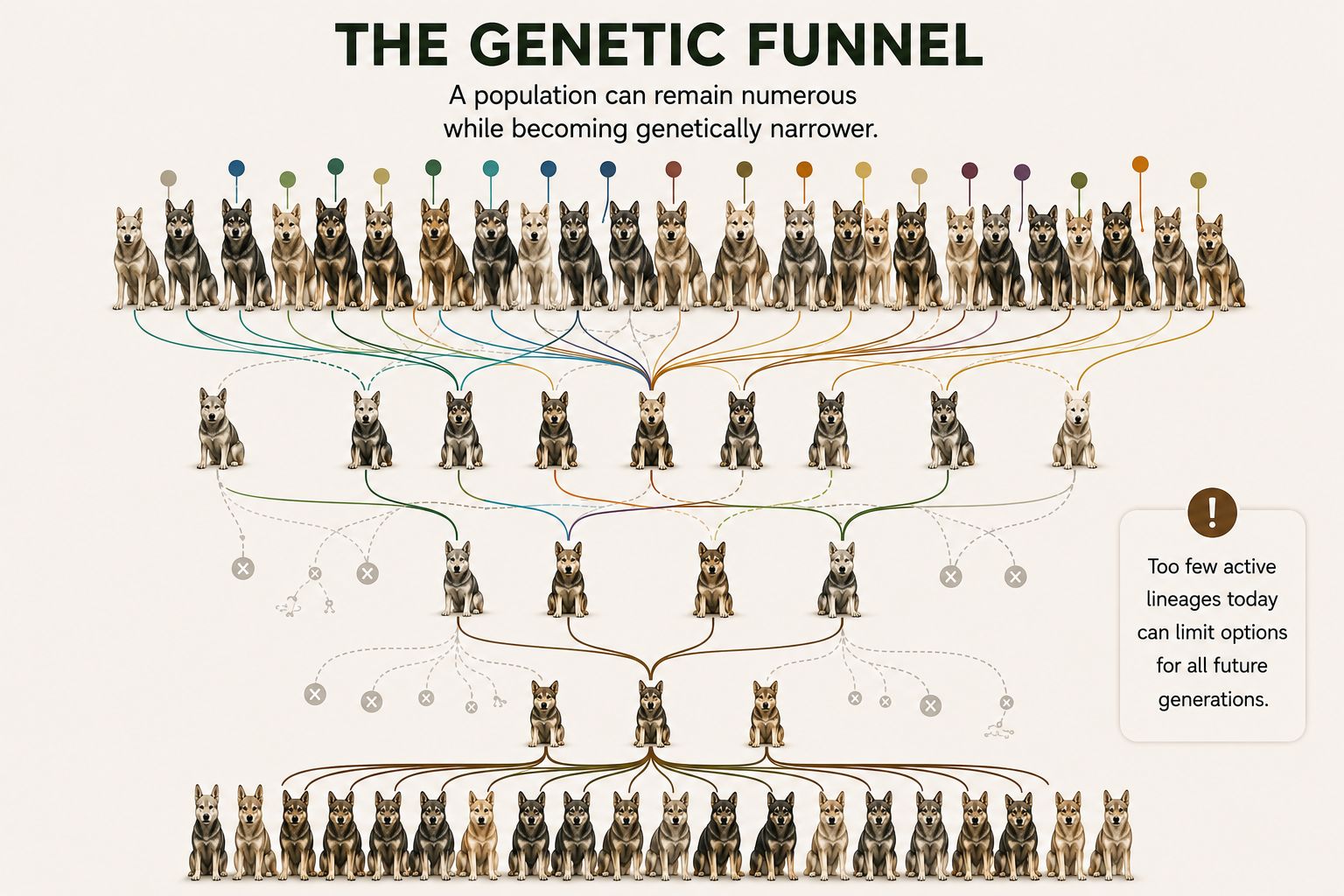
That’s the key point: a breed can have a large number of dogs and yet still have limited diversity if the majority are descended from the same bloodlines or the same breeding stock.
Diversity functions as a reserve of choices. When it is abundant, the breeder can select with a greater margin. When it becomes scarce, they no longer just choose what they want to produce: they choose primarily from what remains possible.
It allows combining qualities, limiting the concentration of deleterious variants, preserving underrepresented lineages, and maintaining a true selection capacity over generations.
Conversely, when this reserve empties, selection becomes more complicated. We no longer choose between several good options. We arbitrate between constraints.
Why Genetic Diversity Is Essential in Dogs
Genetic diversity helps support fertility, immune function, resilience, longevity and the capacity to adapt and respond to selection. It does not guarantee that every dog will be healthy, but it gives the population more options.
Dog breeding often aims to establish consistent physical traits, temperament or working abilities. Those are legitimate goals. Yet selection can only act on the variation that remains.
Without variation, there is little scope for selection.
As a population becomes more genetically uniform, its members are more likely to carry the same variants inherited from shared ancestors. Some are neutral; others may be harmful.
Conservation genetics highlights a central principle: a population needs management that limits genetic drift and the rise in inbreeding, helping it retain the variation required to adapt over successive generations (Frankham et al., 2010).
Genetic diversity and inbreeding: related, but different
Inbreeding measures the increase in homozygosity associated with relatedness. Genetic diversity measures the range of variants available in a population. The two concepts are linked, but do not describe exactly the same thing.
A population with little diversity is more prone to inbreeding because breeding dogs eventually share much of their ancestry. However, an inbreeding coefficient alone cannot describe all the diversity available.
An inbreeding coefficient concerns a risk of homozygosity, whereas genetic diversity concerns the biological resources available. Confusing the two leads to weak reasoning.
The right goal is therefore not “zero inbreeding”: that is unrealistic in a closed breed. The real goal is to slow diversity loss, avoid unnecessary reconcentration and preserve future options.
Which indicators should be monitored?
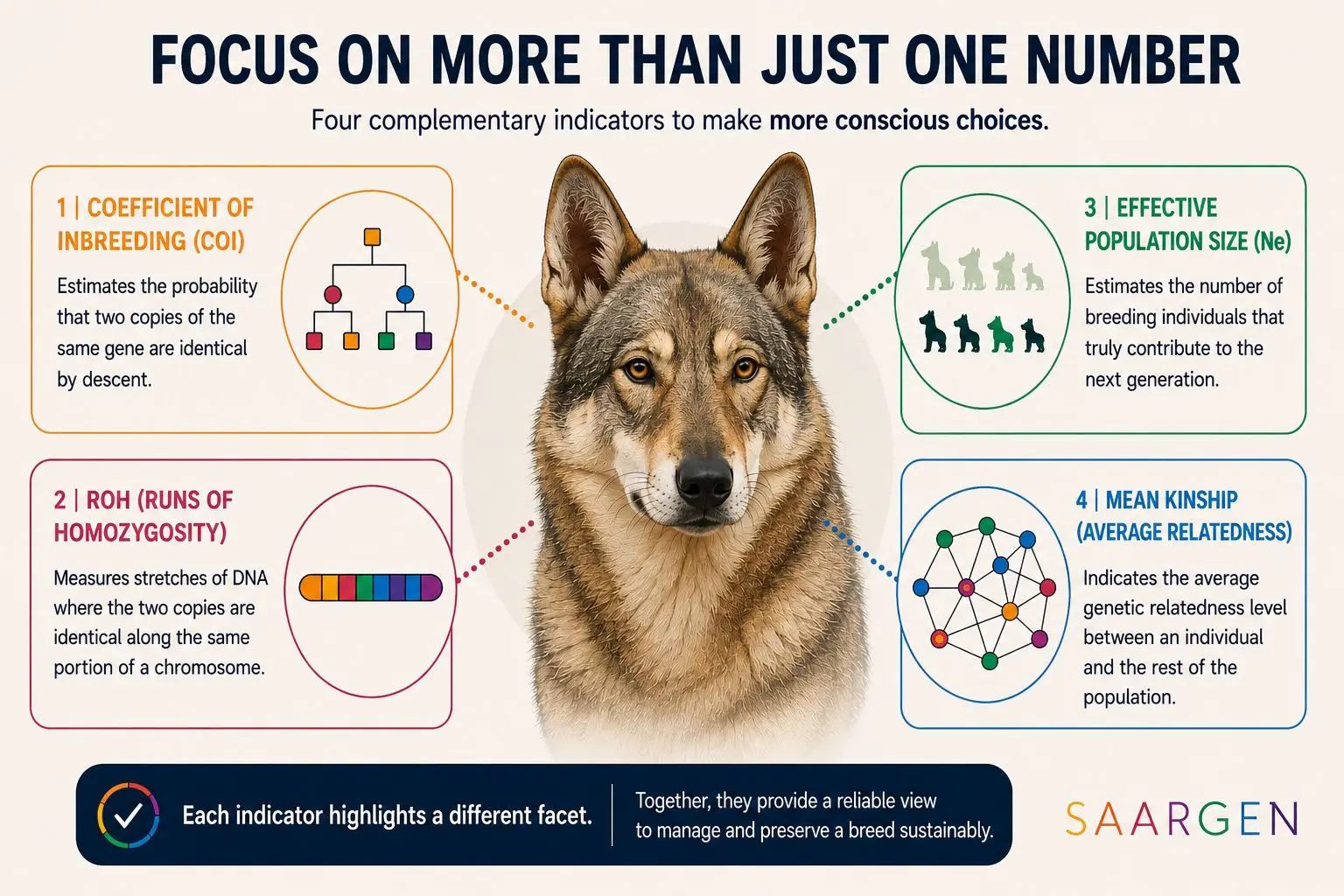
No single indicator captures a breed’s genetic condition. A common mistake is to look for one number and then base the entire decision on it.
The pedigree inbreeding coefficient provides a genealogical estimate. ROH, or runs of homozygosity, show regions of homozygosity actually visible in the DNA.
Effective population size tells us how many breeding dogs genuinely contribute to the next generation.
Mean kinship places a dog in relation to the entire population.
Together, these indicators change the level of analysis: we look beyond one mating to the breed’s trajectory. Genomic measures are particularly useful when pedigrees are incomplete or the available ancestry records fail to capture older inbreeding (Kardos et al., 2015).
What happens when a breed loses diversity?
Loss of diversity is not always immediately visible. Breed type may remain consistent, and the dogs may look much as they always have. Across the population, however, genetic options are narrowing.
Several factors can contribute: a closed studbook, an open studbook that functions as a closed one in practice, bottlenecks, few founders, falling birth numbers, overuse of particular sires and the loss of underrepresented bloodlines.
The main trap is this: in a closed population, a lost variant does not return naturally. Without outside contributions, selection works only with the diversity that remains. It can favour some variants and exclude others, but it cannot recreate those that have disappeared.
Pedigree studies in dogs have shown how breeding practices, closed studbooks and unequal reproductive contributions can lead to substantial losses of diversity and increasing relatedness (Calboli et al., 2008; Leroy, 2011).
The particular challenges of small breeds
In a breed with a small population, the constraints soon extend beyond any individual breeder. Even with careful planning, there may be few suitable breeding options.
A breed may contain several hundred dogs but only a small pool of active, available breeding animals that meet health and selection requirements without being too closely related.
The total headcount can therefore give false reassurance. What matters is effective population size: the dogs that actually pass their genes on to the next generation.
As the genetic breeding base narrows, drift becomes more influential. Variants may disappear by chance, while others become common because heavily used breeding animals carry them. Diversity can decline even without very close matings.
Planning one mating at a time is therefore insufficient. The whole population needs a strategy.
Why Genetic Diversity Is Biological Insurance for Dogs
Genetic diversity can be thought of as biological insurance. It cannot prevent every problem, but it gives a breed more options for responding when problems arise.
Diversity does not conflict with selection. It helps make continued selection possible.
Breeders can still make choices as diversity declines, but within an increasingly restricted range. The compromises become harder: health versus breed type, temperament versus availability, or a lower inbreeding coefficient versus further use of already dominant bloodlines.
With more diversity, selection still requires care and judgement. It simply has a broader genetic foundation on which to build a viable population.
What breeders and breed clubs can do
The first step is to look beyond the proposed pair. A mating may seem reasonable in isolation yet reinforce a pattern that is already excessive across the population.
Breeders and breed clubs can monitor birth numbers, the number of active breeding animals, sire contributions, underrepresented bloodlines, inbreeding coefficients, ROH, mean kinship and trends in effective population size.
They can then address practices that erode diversity: overusing a popular sire, losing less prominent bloodlines, concentrating selection within a few successful families, or comparing coefficients calculated using different methods.
In practice, this requires shared data, consistent criteria, a common understanding of the results and a strategy maintained over time.


What this means for SaarGen
For SaarGen, genetic diversity is central to the program. The Saarlooswolfdog illustrates the challenges of a breed with a narrow genetic base, where preserving breed type cannot be separated from long-term genetic viability.
A structured outcross program is not a cure-all. Poorly managed outside contributions can blur objectives or quickly become concentrated in the same few bloodlines.
SaarGen’s aim is to restore measurable diversity, follow successive generations, assess breeding dogs using several indicators and maintain a clear direction consistent with the breed’s identity.
The intended benefit goes beyond lowering a coefficient. It is to give the population more options: useful variation, more possible combinations, greater scope for selection and less dependence on a few dominant bloodlines.
Dog Genetic Diversity: What to Remember
Genetic diversity is a breed’s biological resource. Fertility, robustness, the capacity for selection and the options available to future generations depend on it.
Inbreeding coefficients, ROH, effective population size and mean kinship are practical tools for guiding decisions. Any one can mislead in isolation; considered together, they provide a fuller picture.
For breeds with small populations, the aim is to maintain a population that can endure, rather than simply find a reassuring number.
Assess proposed matings using several indicators, monitor breeding contributions and consider the consequences for the whole population. This is how breeding decisions can help secure a breed’s future.
Frequently Asked Questions
Sources
Scientific references
The sources below informed this article.
Links to the relevant publications are included in the text.
1- Bannasch, D., Famula, T., Donner, J., Anderson, H., Honkanen, L., Batcher, K., Safra, N., Thomasy, S., & Rebhun, R. (2021). The effect of inbreeding, body size and morphology on health in dog breeds. Canine Medicine and Genetics, 8(1), 12. DOI : 10.1186/s40575-021-00111-4.
2- Calboli, F. C. F., Sampson, J., Fretwell, N., & Balding, D. J. (2008). Population structure and inbreeding from pedigree analysis of purebred dogs. Genetics, 179(1), 593-601. DOI : 10.1534/genetics.107.084954.
3- Frankham, R., Ballou, J. D., & Briscoe, D. A. (2010). Introduction to Conservation Genetics. Cambridge University Press.
4- Kardos, M., Luikart, G., & Allendorf, F. W. (2015). Measuring individual inbreeding in the age of genomics: marker-based measures are better than pedigrees. Heredity, 115(1), 63-72. DOI : 10.1038/hdy.2015.17.
5- Leroy, G. (2011). Genetic diversity, inbreeding and breeding practices in dogs: results from pedigree analyses. The Veterinary Journal, 189(2), 177-182. DOI : 10.1016/j.tvjl.2011.06.016.
6- Meyermans, R., Gorssen, W., Buys, N., et al. (2020). How to study runs of homozygosity using PLINK? A guide for analyzing medium density SNP data in livestock and pet species. BMC Genomics, 21, 94. DOI : 10.1186/s12864-020-6463-x.