
The Saarlooswolfdog:
why a genetic conservation plan has become necessary
The Saarlooswolfdog still exists, but selection within the breed alone no longer guarantees its genetic future.
Low effective population size, high inbreeding, few founders, misleading AVK values and limited breeding options: the signals converge.
Understanding this convergence explains why a managed outcross plan has become necessary.
Key points
It is not a single piece of data that justifies the outcross. It is the convergence of all the data.
The Saarlooswolfdog breed doesn't just lack good dogs. Above all, it lacks genetic diversity at the population level.
The standard protects what is visible: type, silhouette, appearance, and overall impression. It does not measure the remaining diversity, underlying kinship, the ROH, the effective population, or the actual contribution of the breeding stock.
The initial title, open books and past external contributions can help. But they are not enough if the individuals concerned are too few in number, already genetically close to the population or insufficiently distributed.
Internal selection remains essential for managing what still exists. But it is no longer enough to restore a sustainable genetic margin.
The SCC has authorised an outcross plan for the Saarlooswolfdog
The SCC has authorised an outcross plan for the Saarlooswolfdog. This must be understood correctly: the authorisation does not endorse a personal preference for crossing. It recognises that a population assessment requires a managed outcross to be examined.
A serious outcross plan is not an isolated mating, nor permission to produce arbitrary crosses without a direction consistent with the breed. It is a substantial tool, reserved for situations in which internal selection can no longer restore the necessary diversity.
Sound reasoning therefore begins with the assessment. If effective population size is too low, inbreeding remains very high regardless of the method, useful founders are too rare and breeding options are closing, outcrossing ceases to be an ideological debate and becomes a management question.
This is essential to avoid two caricatures. Outcrossing must not be presented as a betrayal of the breed, nor sold as a magic solution. It has value only when structured, measured, documented and followed over several generations.

Crossing is part of the Saarlooswolfdog’s history
The Saarlooswolfdog did not originate as a population that had always been pure, homogeneous, and closed. Its history already reflects a particular genetic foundation, with a narrow base and founding choices that shaped its identity.
Recalling this history does not deny the current standard. It challenges the illusion that any outcross is inherently alien to the breed. A breed is a historical population: constructed, selected, and then stabilized. It is not a biological entity frozen outside time.
The Saarlooswolfdog’s identity is real and must be protected. But it cannot be reduced to the administrative closure of a studbook. Closure can stabilize breed type; it does not guarantee that the population retains enough variation to endure.
The real question is therefore not whether the Saarlooswolfdog has an identity. It does. The question is whether that identity can continue to be sustained by a population whose genetic options are narrowing.
The standard protects what is visible, not genetic viability
The standard is essential. It describes the appearance, proportions, overall movement, and visible characteristics that make a Saarlooswolfdog recognizable. It gives breeders and judges a common direction.
But the standard primarily protects what is visible. It does not measure genetic diversity, effective population size, mean kinship, runs of homozygosity, founder loss, or the actual influence of particular bloodlines.
A breed can therefore continue to produce dogs that show the desired breed type while losing biological options. This is a familiar blind spot in closed populations: appearance can remain consistent while the genetic base contracts.
Preserving the Saarlooswolfdog therefore means more than preserving its image. It also means preserving its ability to produce viable, fertile, stable dogs that offer scope for selection and retain enough diversity to avoid dependence on an ever-narrower circle of breeding dogs.
First warning sign: a critically low effective population size
Under the management criteria used by the FAO - Food and Agriculture Organization) for species with high reproductive capacity, including dogs, a population’s risk level can be assessed from the number of males and females actually breeding. This table does not define an ideal sex ratio: it indicates areas of demographic vulnerability. In practice, a population with too few breeding animals, or excessive reliance on a few males, rapidly loses genetic diversity.
The Saarlooswolfdog’s current worldwide effective population size is estimated below 100. The breed therefore falls within a critical management zone. This does not mean it will disappear tomorrow, but that its genetic safety margin is insufficient: genetic drift acts faster, rare alleles are more easily lost and breeding options diminish.
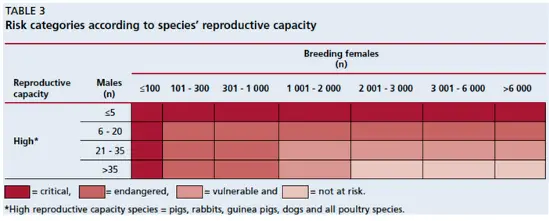
Effective population size is therefore not the same as the total number of living dogs. A breed can contain several hundred dogs but, in practice, have few breeding animals that are actually used, available, compatible and sufficiently unrelated. A population is secured not by its total headcount, but by the actual number of breeding animals, the balance of their contributions and the diversity they pass on.
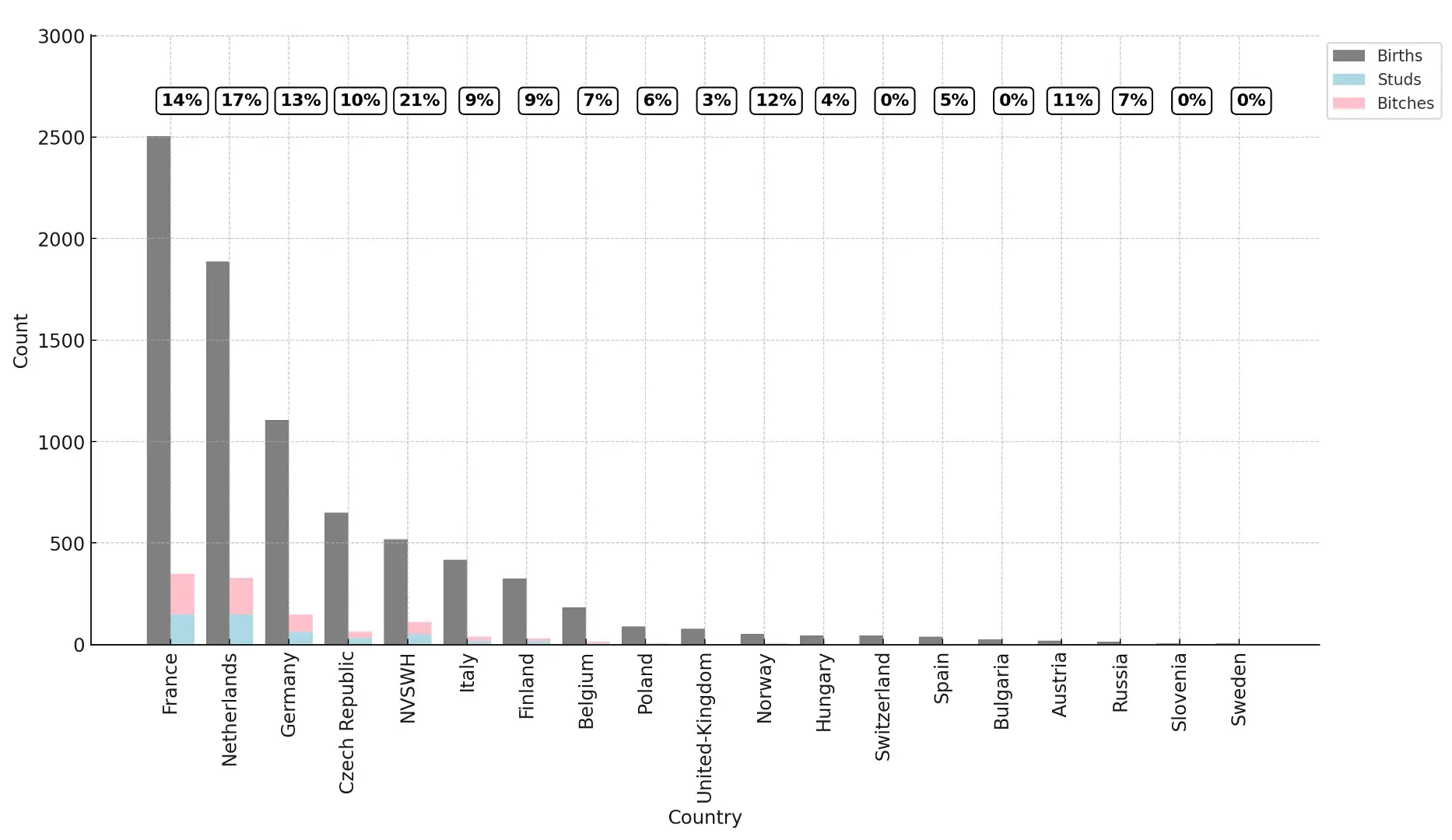
Cumulative production of Saarloos Wolfdogs (grey bars) and number of dogs that contributed to reproduction (pink bars for females and blue bars for males) from 1976 to 2024, by country. The percentages represent the share of breeding dogs in the total population of each country.
This distinction makes the assessment more severe than the visual impression of the breed’s numbers. Seeing Saarlooswolfdogs at shows, in different countries or on social media does not tell us how many actually contribute to the next generation. When effective population size is this low, genetic drift acts faster. Variants disappear simply because some dogs do not breed. Others become common because a few families or breeding dogs carry greater weight. Even without extreme matings, the population becomes more homogeneous, consistent with the classic mechanisms described in conservation genetics (Frankham, Ballou & Briscoe, 2010) and diversity analyses in purebred dogs (Leroy, 2011).
Second warning sign: population trends insufficient to restore the breed
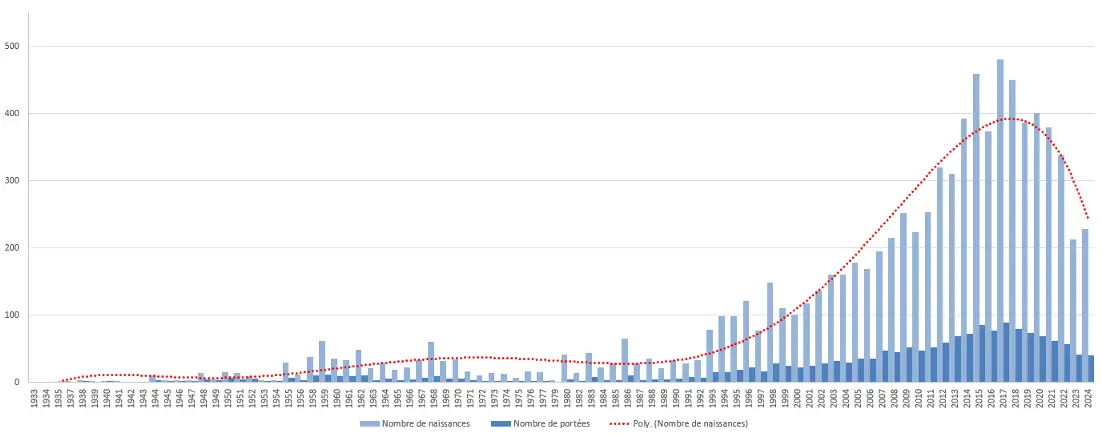
Trends in Saarlooswolfdog births in Europe from 1933 to 2024
Preserving a breed depends on more than the genetic diversity currently available. It also depends on the number of dogs produced, the renewal of the breeding population, and the ability of new bloodlines to spread through the population over successive generations.
The recent decline in Saarlooswolfdog births is therefore another warning sign. A contracting population offers fewer potential breeding dogs, fewer mating options, and less scope to select simultaneously for health, behavior, conformity to the standard, and genetic diversity.
This difficulty is particularly important for SaarGen. Introducing new founders will not be enough if their descendants remain a small minority or make only a marginal contribution to subsequent generations. The diversity reintroduced could then quickly be diluted, lost, or concentrated in too few families.
We therefore need to breed both more dogs and better dogs.
Breeding better means selecting breeding dogs and matings based on health, temperament, genetic complementarity, and their contribution to the population as a whole.
But this improvement in quality must also be accompanied by a sufficient number of births.
Without sufficient numbers, rigorous selection becomes impossible if enough descendants are also to be retained to renew and expand the breeding population.
Continuing to breed exclusively within the current purebred population can no longer restore the genetic diversity that has been lost.
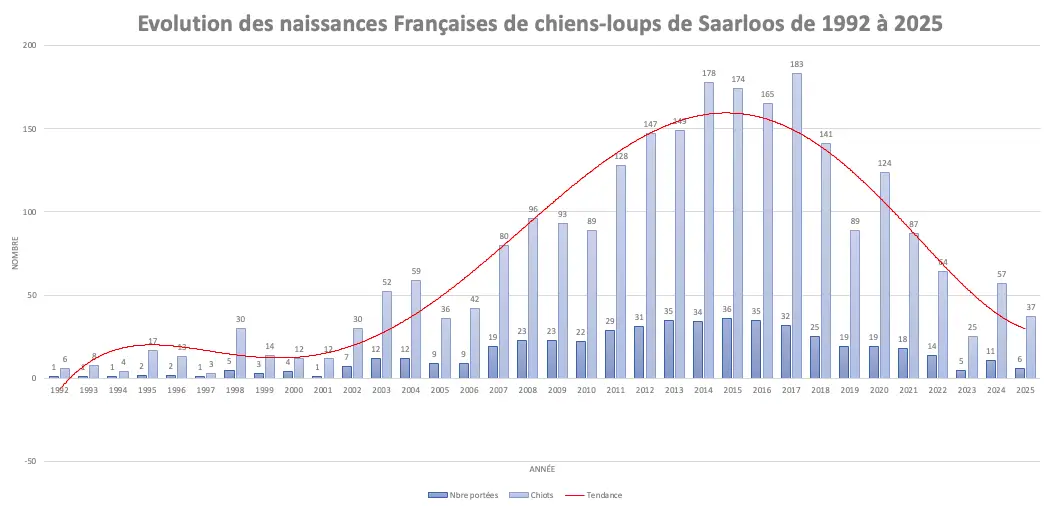
Breeders will therefore face a strategic choice in the coming years. This is not a choice that pits purebred Saarlooswolfdog births against births from the SaarGen program. The purebred population remains essential: it carries the breed’s identity, provides reference points for breed type, maintains existing lines and will remain necessary for future program generations.
However, continuing to concentrate most collective effort solely on internal breeding will not be enough to change the current trajectory. In a population whose diversity is already greatly reduced, purebred selection can still limit some risks, but cannot restore lost genetic resources on its own.
The task is therefore to organise a gradual transition. SaarGen puppies must not remain a small experimental branch. As generations progress, they must become numerous enough, monitored and sufficiently well distributed for selection to operate across several families, generations and genetic combinations.
The aim is not indiscriminate production, but a gradual transfer of part of the breeding effort towards lines capable of preparing the breed’s future, while maintaining a sufficiently monitored purebred Saarlooswolfdog population to support the transition.
SaarGen’s success will depend as much on its gradual integration into the population as on the quality of its genetic program. Reintroducing diversity without producing enough descendants to retain and spread it would merely delay the problem. But ending or delegitimising purebred breeding too early would also weaken the program’s future.
Lasting restoration therefore requires a transition, not abrupt replacement of one population by another, with the current purebred population and SaarGen lines each playing a role in safeguarding the breed.
SaarGen is not intended to replace purebred breeding abruptly, but to prepare a genetic transition that purebred breeding can no longer achieve alone.
Third warning sign: very high inbreeding, whatever the method
The available sources do not all give the exact same figure, because they are not based on the same bases or the same methods.
Bannasch et al. 2021 place the genetic inbreeding of the Saarlooswolfdog at 33.6 % out of 476 dogs based on the data MyDogDNA.
Embark reported an average of approximately 36 % for the Saarloos wolfdogs present in his own database, without publicly confirming the exact number.
Calculations based on pedigrees, on the other hand, place the average inbreeding at around 38 %.
These values are therefore not interchangeable. But they all tell the same story: Saarlooswolfdog is in the very high range of inbreeding.
It would be weak to try to pit these figures against each other to avoid the diagnosis. Yes, the methods differ. No, the bases are not identical. No, the values should not be merged as if they were measuring the exact same thing. But the order of magnitude converges.
This is a crucial point. A high inbreeding does not mean that every dog is sick. It means that the population is highly homogeneous and that the range of possible matings is narrowing. The more breeding dogs share the same genetic background, the more difficult it becomes to find truly complementary pairs.
The danger is therefore not an isolated figure.
The danger lies in the fact that several methods, each based on its own independent logic, all lead to a troubling interpretation. Genomic measures usefully complement pedigree estimates, especially when one wishes to measure the inbreeding—which is actually litter—in individuals (Kardos, Luikart & Allendorf, 2015).
When discussing genomic inbreeding, ROH are particularly useful: they allow us to visualize segments of homozygosity in DNA, with limitations related to thresholds and marker density (Meyermans et al., 2020).
In dogs, these areas deserve special attention because they can harbor deleterious recessive genotypes (Sams & Boyko, 2019).
At the ABNF’s 2024 national breed show, its Saarloos commission presented concerns about the breed’s situation, including inbreeding. The video below presents that talk.
AVK: an indicator that is no longer enough
AVK can provide useful information about the apparent variety of ancestors in a pedigree. It helps identify whether the same ancestors recur frequently within a given number of generations.
But AVK remains a genealogical indicator. It depends on the number of generations analyzed, data completeness, and pedigree structure. It does not directly measure the DNA passed on.
In a population with extensive older shared ancestry, a satisfactory AVK over a few generations can give an impression of diversity. That impression may be misleading if the dogs already share substantial older relatedness.
It would therefore be a mistake to treat AVK as a certificate of genetic safety. It remains useful for interpreting ancestry, but is no longer sufficient to assess the viability of a narrow, closed population.
Why an open studbook and initial registration are not enough
An open studbook and initial registration can be useful. In some cases, they allow outside dogs bringing genetic variation or a different contribution into the breed register.
But the mechanism alone is not enough.
The few dogs admitted through initial registration show that the Saarlooswolfdog’s open studbook can be useful, but remains insufficient if the dogs involved are few, already genetically close to the population or little used in breeding.
Four females have received initial LOF registration. Two were spayed without ever breeding, and one is expected to breed soon. Only one has actually bred, producing three litters totalling 13 puppies, two of which have themselves bred.
The assessment must therefore focus on the actual effect, not the administrative existence of the mechanism. An open studbook without a strategy for spreading contributions, contribution monitoring or kinship analysis may bring limited benefit.
An isolated outcross can look reassuring on paper without changing the genetic trajectory. To have an effect, new contributions must be sufficiently distinct, adequately monitored and genuinely integrated into several breeding branches.
PedCharts: visual proof of the founder dead end
Pedigree visualisations such as PedCharts can reveal repeated ancestry, heavily used sires, bottlenecks and concentration around a small founder base.
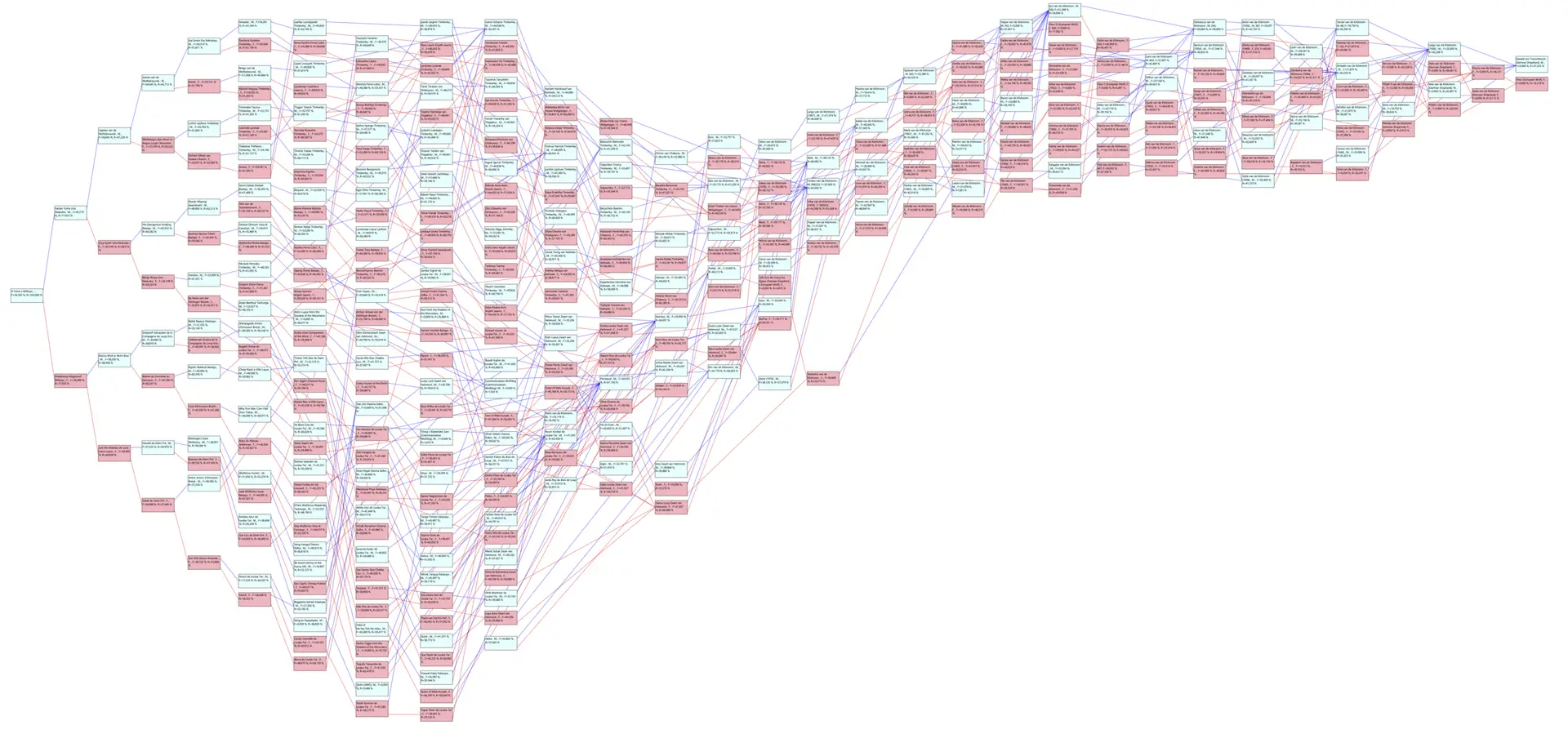
A pedigree read line by line can give an impression of richness. Names change, affixes vary, countries differ. But when the complete structure is visualized, the same roots reappear.
This visualization is useful because it turns an abstract problem into a readable image. It shows that the subject is not limited to avoiding a few recent common ancestors. The problem is deeper: a significant part of the population relies on a very narrow founding base. The message is not that pedigree is no longer useful. On the contrary, it serves to demonstrate the dead end. But it must be read down to the population level, not just over 3, 4, or 5 generations.
Outside contributions have occurred, but without lasting collective management
Some outside contributions were made outside a clear, official collective framework. Their spread remained partial. Some descendants were used individually, sometimes extensively. Part of the community challenged them, and their actual effect on current diversity remained limited.
This history must be approached without naivety. The fact that an outside contribution existed does not prove it saved diversity. Conversely, the fact that it was contested does not prove it was biologically useless.
The main problem is the lack of a lasting collective strategy. Without governance, measurable goals, genomic monitoring and an organised distribution of descendants, an outside contribution can become an isolated episode.
A contribution that is poorly retained, absorbed too quickly or concentrated in a few descendants does not necessarily change the population’s trajectory. It can leave a trace in pedigrees without producing lasting restoration of diversity.
Mean kinship: confirmation of the lack of available options
How to read the display
This interactive 3D visualisation is called a PCoA — principal coordinates analysis. It provides an exploratory view of the mean kinship (Mk) structure among approximately 2,000 Saarlooswolfdogs, based on their pedigree data.
You can freely rotate the point cloud horizontally and vertically, pan and zoom using your mouse or touchscreen. Each coloured point represents a Saarlooswolfdog. Pointing to a dog with your mouse or finger displays its identity, birth year, sex and Mk value. Point colour corresponds to Mk according to the scale on the right. Distances between points represent similarities or differences in mean kinship structure within the population. Dogs close together generally have more similar population-wide kinship profiles, while dogs further apart occupy more distinct genetic positions within this structure.
Interpretation
The observed structure forms a genetic continuum with a dense central core and several peripheral extensions. This pattern is typical of a small closed population that has evolved over generations under the combined effects of genetic drift, unequal reproductive contributions and repeated use of particular bloodlines.
Several visible structures also correspond to known historical trajectories within the breed. A historically very closed Dutch subpopulation evolved for decades with very little mixing with the wider Saarlooswolfdog population, reflected here in strong internal genealogical proximity, high Mk values and a particularly tight grouping.
By contrast, some green points represent dogs from Dutch outcross programmes. Their more peripheral positions and lower Mk values reflect the introduction of genetic contributions less widely represented in the current population. However, known genomic inbreeding levels for several of these dogs remain relatively high, often around 20–30% according to available Embark data. This shows that an outside contribution does not automatically guarantee substantial long-term restoration of genetic diversity.
Some of these dogs also remain relatively close to the main core. This illustrates an important limit of outcross strategies involving substantial reintegration into a closed population: some of the initial diversity gain can gradually be diluted through generations and further internal matings.
Finally, several yellow and green points on the right seem to correspond to lines from earlier undisclosed outcross matings or their descendants. Although long integrated into the Saarlooswolfdog population, these dogs still retain slightly more peripheral positions within the overall kinship structure.
Interpret cautiously: a PCoA is a simplified representation of relative distances and structures. It shows trends, proximity and gradients, but cannot alone measure an individual’s genetic quality, a breed’s overall diversity or the selection decisions required. This visualisation must be interpreted alongside pedigree analyses, population management indicators and genomic data.
When simulations confirm the dead end
Genetic management simulations converge with the assessment on the ground: an outside contribution that is too small, too isolated or reabsorbed too quickly has limited effect. The cross is not the program; it is merely the starting point.
Models of genetic rescue through outcrossing in dogs show that a few litters followed by rapid returns to the original population do not sufficiently slow the increase in inbreeding over the long term. The effect becomes more valuable when the contribution is broad enough, retained and integrated into several breeding branches.
This logic applies directly to the Saarlooswolfdog. An outcross without retention is not enough. Introducing a donor without establishing a path for its descendants is not enough. Producing an F1 generation is not enough.
The meaningful criterion is the ability to retain a useful share of the contribution in subsequent generations while gradually returning towards a coherent Saarlooswolfdog identity. It is a delicate balance: opening without diluting, selecting without closing too quickly.
The internal solution is exhausted
The internal solution is exhausted.
This sentence must be understood precisely. It does not mean that all current dogs are useless, that every lineage is bad, or that breeders must stop selecting with rigor.
It means that internal selection alone can no longer restore lasting diversity if the available base is already too narrow. Internal selection remains necessary to manage what still exists, but it is no longer sufficient to restore a sustainable genetic margin.
In a closed population, selection sorts existing variants. It can better distribute certain contributions, limit certain matings, avoid the overuse of certain breeding animals, and preserve underrepresented lineages. But it does not recreate lost variants.
The diagnosis is therefore severe, but logical: Continuing solely with the same tools in a population that is already too narrow amounts to managing the contraction, not restoring the margin..
What this article does not say
This article does not say that
- all current Saarlooswolfdogs are poor-quality or ill;
- that previous breeders “got it wrong”;
- that outcrossing is magic;
- that breed type must be sacrificed;
- or that pedigrees are no longer useful.
It does say, however, that current indicators leave insufficient scope to preserve the breed solely or mainly through internal selection.
Preserving the Saarlooswolfdog means sustaining its population
The Saarlooswolfdog is more than a standard, a way of moving or an aesthetic response. It is also a living population, with a founding history, actual breeding dogs, bloodlines, remaining diversity and biological constraints.
The assessment is not based on one piece of data, but on convergence: critically low effective population size, high inbreeding whatever the method, a narrow founder base, insufficient AVK, poorly structured past outside contributions, simulations showing the limitations of isolated outcrosses and clear limits to internal selection.
Faced with this convergence, refusing to examine a managed outcross plan would not be prudent. It would ignore the population-level problem and amount to ideology.
Preserving the Saarlooswolfdog means more than preserving its image: it means preserving the population that allows that image to be passed on. Breed identity cannot survive in the long term if the genetic base carrying it continues to contract.
The real issue is not choosing between identity and diversity, but understanding that a vulnerable breed needs diversity to continue existing.
Mini-glossary
Frequently Asked Questions
How is AVK calculated?
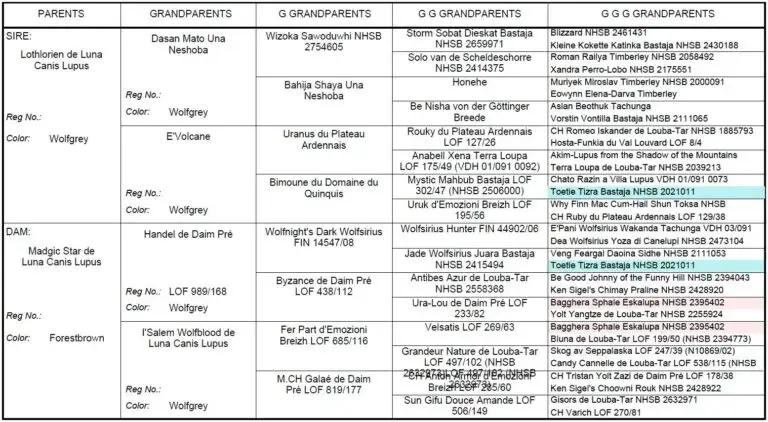
What is NVSWH?
Why consider outcrossing if the Saarlooswolfdog still exists?
Is a Saarlooswolfdog with a high inbreeding coefficient necessarily ill?
Why is initial registration not enough?
Are the Dutch outcross programmes enough?
Will outcrossing change Saarlooswolfdog breed type?
Why not simply select existing Saarlooswolfdogs more carefully?
Sources
Scientific references
The sources below informed this article.
Links to the relevant publications are included in the text.
1. Bannasch, D., Famula, T., Donner, J., Anderson, H., Honkanen, L., Batcher, K., Safra, N., Thomasy, S., & Rebhun, R. (2021). The effect of inbreeding, body size and morphology on health in dog breeds. Canine Medicine and Genetics, 8, 12. DOI : 10.1186/s40575-021-00111-4.
2. Kardos, M., Luikart, G., & Allendorf, F. W. (2015). Measuring individual inbreeding in the age of genomics: marker-based measures are better than pedigrees. Heredity, 115, 63-72. DOI : 10.1038/hdy.2015.17.
3. Meyermans, R., Gorssen, W., Buys, N., et al. (2020). How to study runs of homozygosity using PLINK? BMC Genomics, 21, 94. DOI : 10.1186/s12864-020-6463-x.
4. Sams, A. J., & Boyko, A. R. (2019). Fine-Scale Resolution of Runs of Homozygosity Reveal Patterns of Inbreeding and Substantial Overlap with Recessive Disease Genotypes in Domestic Dogs. G3, 9(1), 117-123. DOI : 10.1534/g3.118.200836.
5. Windig, J. J., & Doekes, H. P. (2018). Limits to genetic rescue by outcross in pedigree dogs. Journal of Animal Breeding and Genetics, 135(3), 238–248. DOI: 10.1111/jbg.12330.
6. Frankham, R., Ballou, J. D., & Briscoe, D. A. (2010). Introduction to Conservation Genetics. Cambridge University Press.
7. Leroy, G. (2011). Genetic diversity, inbreeding and breeding practices in dogs: results from pedigree analyses. The Veterinary Journal, 189(2), 177-182. DOI : 10.1016/j.tvjl.2011.06.016.